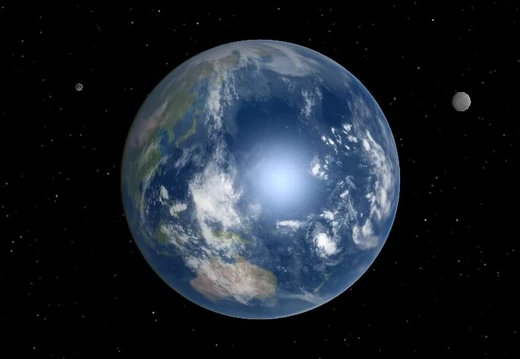
Chrysalis (hypothetical moon)
Hypothetical moon whose breakup may have created Saturn's rings.

Wikipedia / Wikimedia Commons
Chrysalis is the name given to a hypothetical moon of Saturn, proposed in 2022 by researchers at the Massachusetts Institute of Technology who analyzed data from the Cassini–Huygens mission. The moon is thought to have been destroyed by Saturn's tidal forces between 200 and 100 million years ago. In this event, up to 99% of Chrysalis's mass would have been pulled into Saturn itself, while the remaining 1% is believed to have coalesced into the planet's rings. The idea that Saturn's rings originated from the destruction of a satellite had been suggested by other scientists before.
The hypothetical moon was thought to be comparable in size and mass to Iapetus, with a similar composition of water ice, and to have orbited Saturn in a region between Iapetus and Titan. Its orbit may have become unstable due to Titan's orbit expanding, a process linked to interactions between the Saturnian system and a resonance with Neptune. This would have increased the eccentricity of Chrysalis's orbit until a close approach to Saturn caused the planet's gravity to tear it apart.
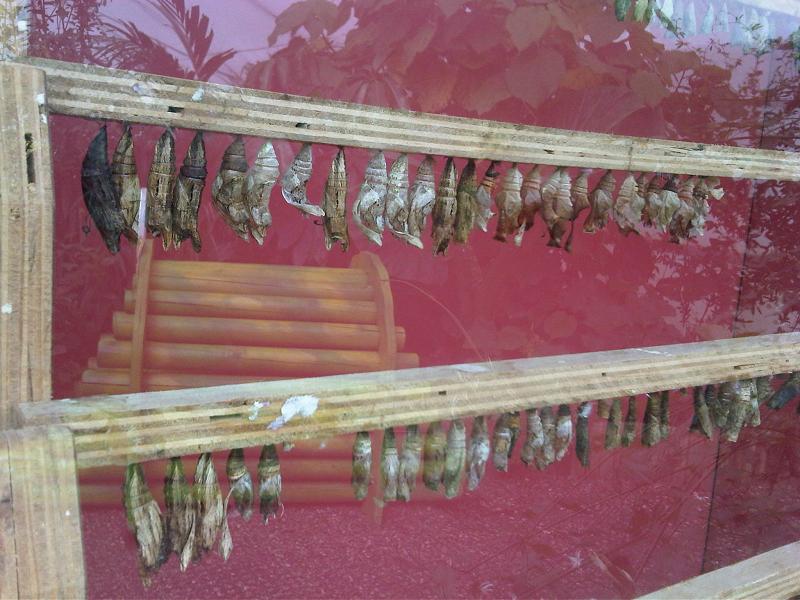
The name Chrysalis was chosen to evoke the pupa stage of a butterfly, with Saturn's rings representing the moon's emergence from that chrysalis.
- field
- Planetary science
- known_for
- Hypothetical moon whose destruction may have formed Saturn's rings
- proposed_by
- Scientists of the Massachusetts Institute of Technology
- named_after
- The pupa stage of a butterfly
- hypothesized_size
- Similar in size and mass to Iapetus
- hypothesized_composition
- Water-ice
- hypothesized_orbital_location
- Between Iapetus and Titan
Lore & Background
Chrysalis is hypothesized to have been a moon of Saturn similar in size and mass to Iapetus, with a water-ice composition, orbiting between Iapetus and Titan. Its orbit may have been degraded as Titan's orbit expanded due to interactions of the Saturnian system with a resonance with Neptune, increasing Chrysalis's orbital eccentricity until it was torn apart during a close encounter with Saturn by the planet's gravitational force.
Reader's Guide
The significance of Chrysalis lies in its proposed role as the origin of Saturn's rings, a long-standing mystery in planetary science. The hypothesis, based on Cassini–Huygens data and named in 2022, suggests that the destruction of a satellite similar to Iapetus could explain the rings' composition and age. While the idea that rings arise from a destroyed satellite had been previously proposed by other authors, Chrysalis provides a specific candidate with a plausible orbital history tied to Titan's migration and Neptune resonance. The moon's name, after the pupa stage of a butterfly, metaphorically links its destruction to the emergence of the rings. This hypothesis remains unconfirmed but offers a coherent narrative for the rings' formation within the past 200 to 100 million years.
Did You Know?
- Chrysalis was named in 2022 by scientists at the Massachusetts Institute of Technology using data from the Cassini–Huygens mission.
- Up to 99% of Chrysalis's mass would have been swallowed by Saturn, with the remaining 1% forming the rings.
- The moon is hypothesized to have been torn apart by Saturn's tidal forces between 200 and 100 million years ago.
- Chrysalis was hypothesized to be similar in size and mass to Iapetus, with a water-ice composition.
Discovery, Naming, and the Butterfly Metaphor
In 2022, a team of researchers at the Massachusetts Institute of Technology introduced a name for what they proposed was once a real moon orbiting Saturn. Drawing on observational data gathered during the Cassini–Huygens mission, the scientists identified orbital and compositional signatures consistent with a former satellite that no longer exists as a coherent body. They christened this vanished world Chrysalis, borrowing the term from the pupal stage of a butterfly's life cycle. The metaphor is deliberately evocative: just as a caterpillar dissolves inside its chrysalis before wings emerge, the hypothetical moon would have been consumed by its parent planet, with the debris that survived reorganizing into the spectacular ring system we observe today. The naming thus encodes both the destruction and the transformation at the heart of the hypothesis. By attaching a recognizable biological image to an otherwise abstract orbital calculation, the researchers gave the public a vivid way to picture how a solid body can be unmade and reassembled into something entirely different, turning a cold gravitational calculation into a story of metamorphosis written in ice and rock.
The Tidal Shattering and Ring Formation
The central event in the Chrysalis hypothesis is a catastrophic tidal disruption. Somewhere between two hundred and one hundred million years ago, the moon's orbit had degraded enough to bring it into a dangerously close pass with Saturn. During that encounter, the planet's gravitational field stretched the satellite beyond the point at which self-gravity could hold it together, and the body was torn apart. The fate of the fragments was overwhelmingly one-directional: up to ninety-nine percent of the original mass was drawn back into Saturn itself, effectively swallowed by the gas giant. The remaining one percent, however, escaped immediate re-accretion and settled into orbit around the planet, coalescing over time into the main ring system that makes Saturn visually distinctive. This scenario places Chrysalis squarely in the category of a progenitor body for the rings, a possibility that other researchers had floated before the 2022 MIT work. What distinguishes the Chrysalis proposal is its attempt to specify the orbital pathway and the physical parameters that would make such a disruption dynamically plausible within the broader Saturnian system.
Composition, Orbit, and the Role of Titan
The researchers described Chrysalis as broadly comparable to Iapetus in both size and total mass, and they assigned it a water-ice composition similar to that of Iapetus's surface. Its orbital position is hypothesized to have fallen between the orbits of Iapetus and Titan, placing it in a region of the Saturnian system where gravitational interactions are particularly complex. The mechanism that ultimately doomed the moon is linked to Titan. Over geological timescales, Titan's orbit has been slowly expanding, a process driven by the Saturnian system's gravitational resonance with Neptune. As Titan drifted outward, the orbital architecture of neighboring bodies shifted. Chrysalis's orbit, already in a sensitive region, experienced a gradual increase in eccentricity. Each successive orbit carried the moon slightly closer to Saturn at pericenter. Over millions of years this slow degradation accumulated until a single close encounter became fatal, and the tidal forces exceeded the satellite's structural integrity. The hypothesis thus weaves together the fates of three major Saturnian bodies—Titan, Iapetus, and the vanished Chrysalis—into a single causal chain.
Place in the Broader Scientific Conversation
The Chrysalis hypothesis does not emerge in isolation. The idea that Saturn's rings could be the debris of a shattered satellite has been advanced by other authors in prior work, so the 2022 MIT contribution sits within an ongoing scholarly conversation rather than representing a wholly novel concept. The moon also belongs to a wider catalogue of hypothetical Solar System objects—bodies inferred from orbital dynamics, compositional gaps, or gravitational anomalies but never directly observed. In that context, Chrysalis is a cousin of other proposed lost satellites such as Phaeton, which has been invoked to explain features of the outer Solar System. The primary evidentiary foundation for the Chrysalis model rests on data collected by the Cassini–Huygens mission, the same spacecraft whose observations have reshaped understanding of Saturn's rings, moons, and magnetosphere. Further technical detail appears in conference proceedings from the Lunar and Planetary Science Conference, where the full orbital modeling is laid out. For readers interested in the broader taxonomy of such phantom bodies, the list of hypothetical Solar System objects serves as a useful cross-reference, situating Chrysalis among dozens of other worlds that may have once existed but left only gravitational and compositional traces behind.
Gallery

Frequently Asked Questions
What is Chrysalis (hypothetical moon)?
Chrysalis is a proposed, now-vanished moon of Saturn that likely existed until roughly 100–200 million years ago. It is thought to have been comparable in size and mass to Iapetus and composed primarily of water-ice.
Who proposed Chrysalis and when?
A team of researchers at the Massachusetts Institute of Technology put forward the Chrysalis hypothesis in 2022, drawing on orbital data collected during the Cassini–Huygens mission. Their work built on earlier suggestions by other scientists that Saturn's rings could be the debris of a shattered satellite.
What happened to Chrysalis?
Saturn's tidal gravity is believed to have torn the moon apart, dragging up to 99 percent of its mass into the planet's upper atmosphere while the remaining percent settled into orbit as ring material. The event would have occurred somewhere between 200 and 100 million years ago.
How does Chrysalis explain Saturn's rings?
In the MIT model, the roughly one-percent fraction of Chrysalis that escaped being swallowed by Saturn coalesced into the planet's current ring system. This gives a single, dramatic origin story for rings that had previously been attributed to various other processes.
Why is the moon called Chrysalis?
The name references the pupa stage of a butterfly, evoking the idea of a transformation in which one structure dissolves to give rise to something entirely new. In that metaphor, Chrysalis 'dies' as a moon and is reborn as Saturn's rings.
More in Hypothetical astronomical objects 1-24
Spotted an error? Know more?
This is a living reference — every entry is fact-audited, and reader corrections feed straight into our audit queue. Suggest an edit · See this site's audit record