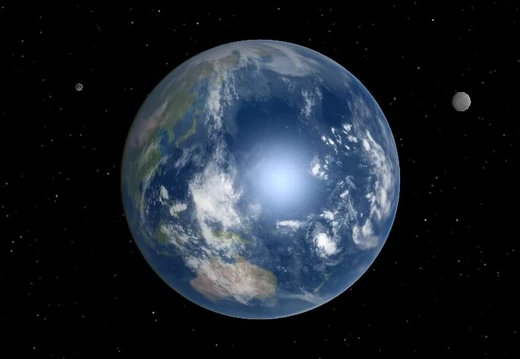
Exomoon
Extrasolar moons remain unconfirmed but are theorized and sought.

Wikipedia / Wikimedia Commons
An exomoon, also called an extrasolar moon, is a natural satellite that goes around an exoplanet or any other non-stellar body beyond our solar system. Detecting and confirming these moons is very difficult with current methods, and so far, none have been officially confirmed. However, missions like Kepler have spotted several possible candidates. Two additional candidate exomoons, which might orbit rogue planets, have been identified through microlensing. In September 2019, astronomers suggested that the strange dimming of Tabby's Star could be caused by debris from a shattered orphaned exomoon. Some exomoons could also be suitable places for extraterrestrial life. One possible exomoon, which might be habitable if it exists, has been found around one part of the binary rogue planet system 2MASS J11193254−1137466 AB.
**Definition and designation** Traditionally, moons orbit planets, but the discovery of brown dwarfs with planet-sized satellites has blurred this line because brown dwarfs are low in mass. The International Astronomical Union (IAU) clarified this by stating that objects with true masses below the deuterium fusion limit, which orbit stars, brown dwarfs, or stellar remnants, and have a mass ratio with their central object below a certain instability threshold, are considered planets. The IAU definition does not cover the naming of satellites around free-floating objects that are less massive than brown dwarfs and below the deuterium limit—these objects are often called free-floating planets, rogue planets, or isolated planetary-mass objects. Their satellites are typically referred to as exomoons in scientific literature. Exomoons are named after their parent body, followed by a capital Roman numeral in order of discovery; for example, the candidate moon of Kepler-1625b is called Kepler-1625b I.
**Characteristics** The traits of extrasolar satellites are expected to vary widely, much like the diversity seen among moons in our own solar system. In particular, extrasolar giant planets that orbit within their star's habitable zone could host large natural moons. Under the right conditions, a sufficiently massive satellite—potentially as large as a terrestrial planet—could keep an atmosphere and liquid water, making it a possible home for life. In August 2019, astronomers reported that an exomoon in the WASP-49b exoplanet system might be volcanicall
- field
- Astronomy, Exoplanetology
- known_for
- Natural satellites orbiting exoplanets or non-stellar extrasolar bodies
- detection_status
- No confirmed detections as of the source article
- detection_methods
- Direct imaging, microlensing, pulsar timing, transit timing effects, transit method
Lore & Background
Exomoons take their designation from that of their parent body plus a capital Roman numeral in order of discovery; for example, the candidate moon of Kepler-1625b is designated as Kepler-1625b I. The characteristics of extrasolar satellites are expected to vary widely, in a manner similar to the diversity observed among the Solar System's moons. In particular, extrasolar giant planets that orbit within their star's habitable zone may host large natural satellites. Under favorable conditions, a sufficiently massive satellite potentially comparable in size to a terrestrial planet could retain an atmosphere and liquid water, making it a possible candidate for supporting life. In August 2019, astronomers reported that an exomoon in the WASP-49b exoplanet system may be volcanically active.
Reader's Guide
Exomoons represent a frontier in exoplanetary science, as their detection would expand the known diversity of planetary systems and potential habitats for life. The source article notes that no exomoon has been confirmed, but candidate detections exist from Kepler and microlensing surveys. The study of exomoons informs models of moon formation, orbital dynamics, and tidal heating. For example, tidally heated exomoons could shine as brightly as some exoplanets, potentially allowing direct imaging with future telescopes like the James Webb Space Telescope. The lack of moons around planets close to their stars is explained by tidal evolution: planets close to their stars become tidally locked, and their synchronous orbit radius moves outside the Hill sphere, causing moons to spiral into the planet or escape. This understanding helps refine detection strategies. The significance of exomoons lies in their potential to host life and in the technical challenges they pose, driving innovation in detection methods such as transit timing variations and microlensing.
Did You Know?
- Two potential exomoons that may orbit rogue planets have been detected by microlensing.
- In September 2019, astronomers reported that observed dimmings of Tabby's Star may have been produced by fragments from the disruption of an orphaned exomoon.
- A possible habitable exomoon has been discovered around one component of the binary rogue planet 2MASS J11193254−1137466 AB.
- Exomoons take their designation from that of their parent body plus a capital Roman numeral in order of discovery.
Frequently Asked Questions
What is an exomoon?
An exomoon is a natural satellite that circles an exoplanet or another non-stellar body located outside our solar system. The phrase 'extrasolar moon' is sometimes used as a synonym. Unlike Earth's Moon, no exomoon has ever been definitively spotted.
Has any exomoon been officially confirmed?
No. Despite years of searching with multiple techniques, astronomers have not yet secured a verified detection of an exomoon. They remain a theoretical class of object that scientists actively hunt for.
What methods do scientists use to hunt for exomoons?
Researchers rely on a toolkit that includes direct imaging, gravitational microlensing, pulsar timing, transit timing effects, and the standard transit method. Each approach looks for a different gravitational or photometric signature that a moon might imprint on its host planet.
Are there any exomoon candidates out there?
Yes. The Kepler mission flagged several possible candidates, and microlensing surveys have identified two additional objects that might be orbiting rogue planets. None of these have crossed the threshold into a confirmed discovery.
Could Tabby's Star be linked to an exomoon?
In September 2019, a team of astronomers proposed that the star's odd, irregular dimming could be caused by debris left behind after a shattered orphaned exomoon broke apart. This remains a speculative hypothesis rather than an established explanation.
More in Hypothetical astronomical objects 1-24
Spotted an error? Know more?
This is a living reference — every entry is fact-audited, and reader corrections feed straight into our audit queue. Suggest an edit · See this site's audit record