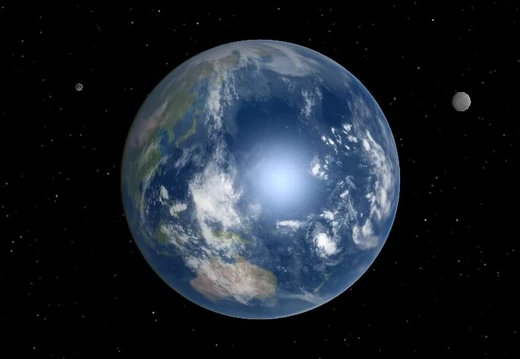
Disrupted planet
A planet destroyed by a star or black hole.

Wikipedia / Wikimedia Commons
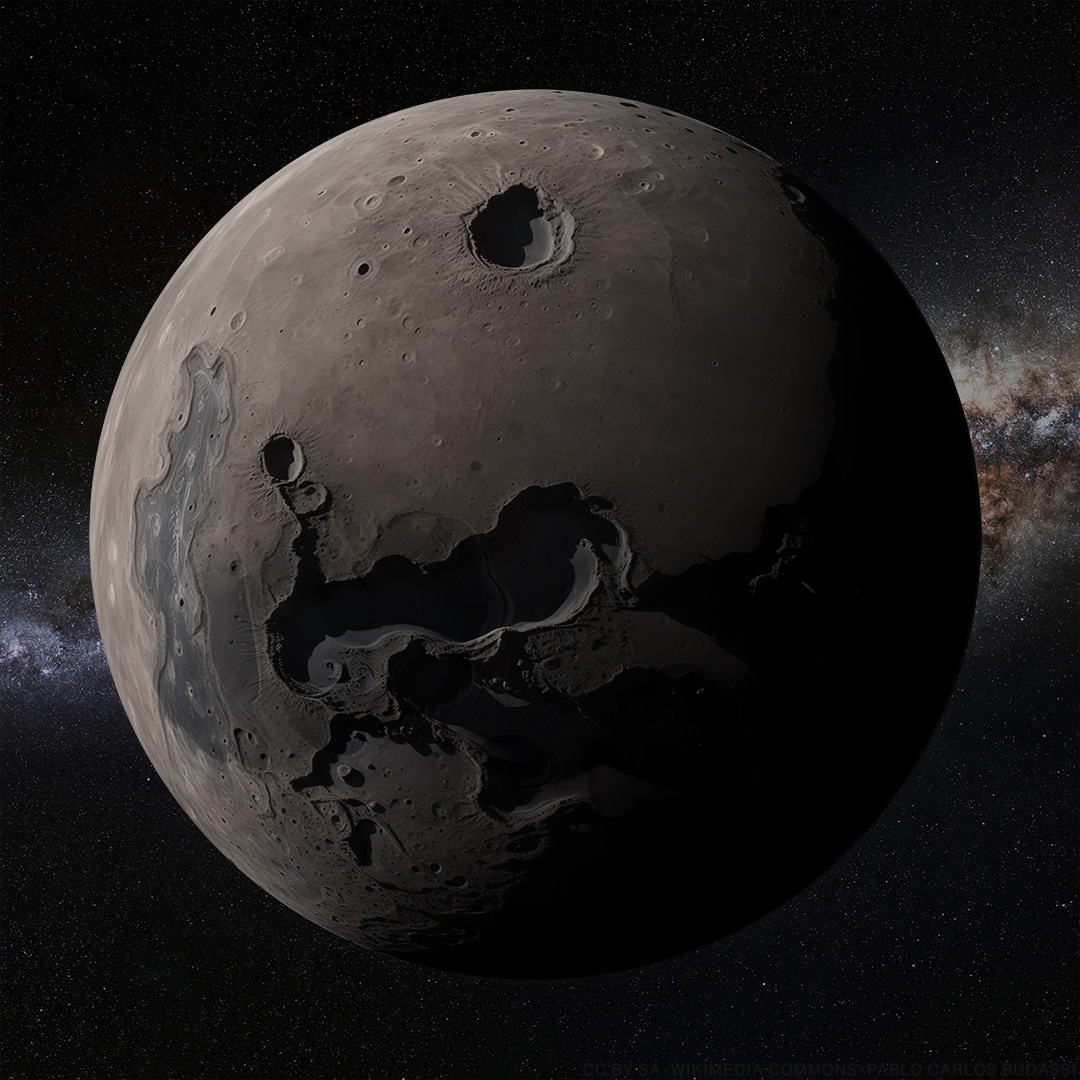
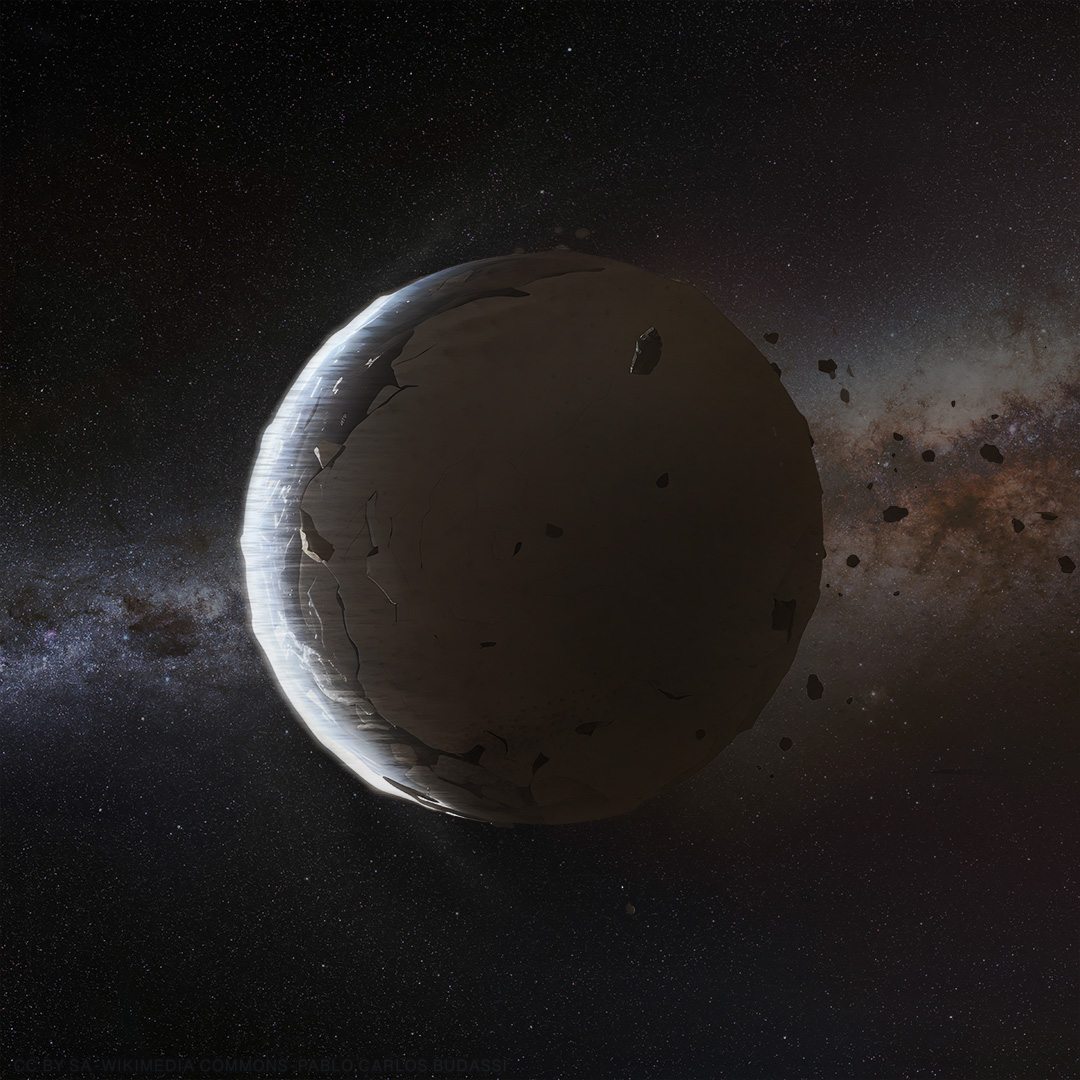
A disrupted planet is a planet, exoplanet, or smaller planetary-mass object such as a planetesimal, moon, exomoon, or asteroid that has been destroyed by a nearby or passing astronomical body, such as a star. The study of this process is called necroplanetology. The disruption can produce large amounts of gas, dust, and debris, which may form a circumstellar or debris disk around the parent star.
- field
- Astronomy
- known_for
- Destruction of planetary bodies by stars or black holes, producing debris disks and erratic starlight fluctuations
- examples
- ‘Oumuamua, WD 1145+017 b, Tabby's Star, RZ Piscium, IGR J12580+0134
Lore & Background
Disrupted planets result from gravitational interactions with nearby stars, black holes, or other massive objects. The debris from such events can form an uneven ring of dust, causing erratic dimming of the parent star's light, as observed with Tabby's Star (KIC 8462852), RZ Piscium, and WD 1145+017. Excessive infrared radiation from these stars is suggestive evidence of orbiting dust and debris.
Reader's Guide
The concept of a disrupted planet is significant because it explains unusual light curves in variable stars, such as the 22% dimming seen in Tabby's Star. The debris field from a disrupted planet can produce erratic light fluctuations, offering a potential explanation for phenomena that otherwise resist full explanation. The study of necroplanetology helps astronomers understand planetary system evolution and the fate of bodies that stray too close to their parent star or a black hole. Examples include the tidal disruption of a Jupiter-like object by the supermassive black hole IGR J12580+0134 in galaxy NGC 4845. Hypothetical disrupted planets in the Solar System include the Fifth planet, Phaeton, Planet V, and Theia.
Did You Know?
- Necroplanetology is the study of disrupted planets.
- Tabby's Star dims by up to 22% in brightness, possibly due to an uneven ring of dust from a disrupted planet.
- A Jupiter-like object was disrupted by the supermassive black hole IGR J12580+0134 in galaxy NGC 4845.
- Excessive infrared radiation from a star can indicate orbiting dust and debris from a disrupted planet.
The Orbital Puzzle That Sparked a Century of Searching
After Neptune was confirmed in 1846, astronomers noticed that Uranus and Neptune still did not quite behave as Newtonian mechanics predicted. This residual wobble became the seed for a decades-long quest. Even before Neptune's discovery, figures like Bouvard and Hansen had mused that Uranus's strange motion might require more than one unseen body. In 1848, Jacques Babinet proposed a planet he called Hyperion at 48 AU, though Le Verrier dismissed it as mere imagination. Later, Camille Flammarion pointed to comet aphelia clustering around 47 and 49 AU as evidence of an unknown world, and George Forbes went further, calculating orbital elements for two trans-Neptunian planets based on comet distributions. William Henry Pickering launched dedicated searches at Harvard in 1900 and 1901. These early efforts, though ultimately fruitless, established the intellectual framework that would drive the search for over a century.
Lowell's Gambit and the Pluto Misfire
Percival Lowell elevated the search to a new level in the early twentieth century, formally proposing that a large unseen planet was gravitationally tugging at Uranus and Neptune. His hypothesis gave the quest a concrete target and a devoted following. In 1930, Clyde Tombaugh discovered Pluto, and for a time it appeared to confirm Lowell's vision. However, by 1978, astronomers had determined that Pluto was far too small for its gravity to produce the perturbations Lowell had attributed to it. This triggered a brief renewed search for a true tenth planet, but the effort largely fizzled out in the early 1990s. The decisive blow came when analysis of Voyager 2 measurements revealed that the original irregularities in Uranus's orbit were simply the result of Neptune's mass having been slightly overestimated. The entire premise of the search had been an artifact of imprecise data, not a hidden world.
The Kuiper Belt and Pluto's Demotion
The discovery of numerous small icy bodies beyond Pluto's orbit after 1992 fundamentally reshaped the Solar System's taxonomy. These objects, many with orbits as wide or wider than Pluto's, forced astronomers to confront whether Pluto truly deserved its planetary title. Several larger members of this newly recognized population were initially called planets, but the debate intensified rapidly. In 2006, the International Astronomical Union drew a definitive line, reclassifying Pluto and its largest neighbors as dwarf planets. This decision left Neptune as the outermost confirmed planet and erased the very category that had anchored the original Planet X search. The reclassification also meant that any future hypothetical world beyond Neptune could no longer inherit the traditional numbering, since Pluto had already occupied that slot in the public imagination.
Planet Nine and the Modern Search
Despite broad consensus that Lowell's Planet X never existed, the idea of an unseen outer world has experienced a remarkable revival. In 2014, astronomers noticed that a cluster of extreme trans-Neptunian objects shared striking orbital similarities, prompting the hypothesis of a super-Earth or ice giant with a mass between two and fifteen times that of Earth, orbiting beyond 200 AU on a highly inclined path reaching roughly 1,500 AU. By 2016, refined calculations narrowed the orbit to an eccentric, inclined ellipse spanning approximately 200 to 1,200 AU from the Sun, with its alignment anti-correlated to the clustered objects. Meanwhile, WISE telescope observations had already ruled out a Saturn-mass body out to 10,000 AU and a Jupiter-mass or larger object out to 26,000 AU, setting firm boundaries on what this hypothetical world could be. Because Pluto no longer holds planetary status, the new candidate is now known as Planet Nine.
Gallery

Frequently Asked Questions
What is a disrupted planet?
A disrupted planet is any planetary-mass body—ranging from a full exoplanet down to a moon, planetesimal, or asteroid—that has been torn apart by the gravitational or tidal forces of a nearby star or black hole. The term covers both confirmed and candidate cases observed in our galaxy.
What field of study deals with disrupted planets?
The discipline is called necroplanetology, a subfield of astronomy focused on how and why stars, black holes, and other massive objects destroy planetary bodies. It sits alongside related areas like exoplanet science and stellar astrophysics.
What observable effects does a disrupted planet produce?
The breakup releases enormous quantities of gas, dust, and rocky debris, which can coalesce into a circumstellar or debris disk orbiting the parent star. Astronomers often detect these events through irregular dips and fluctuations in the star's light curve as the debris transits across its face.
Are there any well-known examples of disrupted planets?
Several candidates are frequently cited, including the interstellar object 'Oumuamua, the transiting debris system around WD 1145+017 b, the puzzling dimming of Tabby's Star (KIC 8462852), the eclipsing binary RZ Piscium, and the tidal-disruption event IGR J12580+0134. Each shows different signatures—dust clouds, asymmetric light curves, or X-ray flares—consistent with a body being shredded by a more massive neighbor.
Why do disrupted planets matter to astronomers?
They offer a direct window into how planetary systems die, letting researchers test models of tidal physics, debris-disk formation, and the late-stage evolution of stars and compact objects. Studying them also helps explain some of the most baffling and erratic light-curve anomalies seen in stellar surveys.
More in Hypothetical astronomical objects 1-24
Spotted an error? Know more?
This is a living reference — every entry is fact-audited, and reader corrections feed straight into our audit queue. Suggest an edit · See this site's audit record