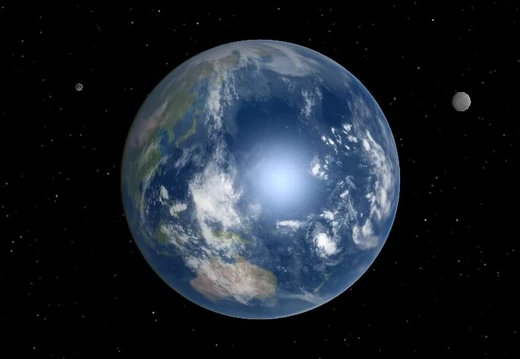
Cosmic string
Hypothetical 1D defects from early universe symmetry breaking.

Wikipedia / Wikimedia Commons
Cosmic strings are hypothetical 1-dimensional topological defects that may have formed during a symmetry-breaking phase transition in the early universe when the topology of the vacuum manifold was not simply connected. They are long, thin defects in the fabric of space, first contemplated by theoretical physicist Tom Kibble in the 1970s. Their existence is a fairly generic prediction in both quantum field theory and string theory models of the early universe.
- type
- Hypothetical topological defect
- first_proposed_by
- Tom Kibble
- proposed_in
- 1970s
- field
- Cosmology, quantum field theory, string theory
- key_property
- Extremely thin, immense density, gravitational wave sources
- typical_width
- ~1 fm (proton diameter) or smaller
- tension_scale
- Expected around 6 orders of magnitude below critical value
Lore & Background
Cosmic strings are analogous to imperfections that form between crystal grains in solidifying liquids or cracks when water freezes into ice. The phase transitions leading to their production likely occurred just after cosmological inflation. The prototypical field theory example is the Abelian Higgs model, while in superstring theory, cosmic strings can be played by fundamental strings (F-strings), D-strings, or higher-dimensional branes partially wrapped on compact cycles.
If they exist, cosmic strings would be extremely thin, with diameters on the order of a proton's (~1 fm) or smaller. They are often studied in the zero-width Nambu–Goto approximation, where they behave as one-dimensional objects. A string is a geometrical deviation from Euclidean geometry characterized by an angular deficit: a circle around the string would comprise a total angle less than 360°. Even though extremely thin, they would have immense density—a kilometer-long string may be more massive than Earth.
General relativity predicts that the gravitational potential of a straight string vanishes, with no gravitational force on static surrounding matter; its only gravitational effect is a relative deflection of matter or light passing on opposite sides. A closed string gravitates more conventionally. In 1995, Visser et al. proposed that cosmic strings could theoretically exist with angle excesses, leading to negative tension and negative mass, potentially stabilizing wormholes. Super-critical strings (with tension exceeding a critical value) lead to unstable, expanding spacetimes, but realistic strings are expected to be sub-critical.
Reader's Guide
Cosmic strings represent a key intersection of particle physics, cosmology, and general relativity. Though purely hypothetical, they are a generic prediction of many early-universe models. Their potential gravitational effects—such as producing duplicate images of galaxies or the cosmic microwave background—have been searched for but not confirmed. Observations from galaxy surveys and precision CMB measurements (including the Planck mission) have failed to find evidence, limiting their contribution to structure formation to less than 10%. The strongest potential signal would be gravitational radiation from oscillating loops, which may be detectable by future observatories. The concept remains important theoretically, as it bridges field theory and string theory, and continues to motivate research into topological defects and early-universe physics.
Did You Know?
- A cosmic string about a kilometer in length may be more massive than the Earth.
- The existence of cosmic strings was first contemplated by theoretical physicist Tom Kibble in the 1970s.
- In 1995, Visser et al. proposed that cosmic strings could theoretically exist with negative mass.
- A 2013 analysis of data from the Planck mission failed to find any evidence of cosmic strings.
Origins in the Early Universe
Cosmic strings are hypothetical one-dimensional defects in the fabric of space, first contemplated by theoretical physicist Tom Kibble in the 1970s. They would have formed during symmetry-breaking phase transitions in the earliest moments of the universe, shortly after cosmological inflation. The key condition is that the topology of the vacuum manifold associated with the broken symmetry must not be simply connected. A useful analogy comes from everyday physics: just as imperfections appear between crystal grains when a liquid solidifies, or cracks form as water freezes into ice, cosmic strings represent topological imperfections frozen into the structure of spacetime itself. Their production is considered a fairly generic prediction across both quantum field theory and string theory models of the early universe, making them a natural consequence of how fundamental symmetries break down as the cosmos cools and evolves.
Theoretical Frameworks and String Theory Roles
The prototypical field-theoretic example of cosmic strings is the Abelian Higgs model, where the string width is set by the scale of the symmetry-breaking transition. In quantum field theory, these strings are treated almost exclusively as classical objects. In superstring theory, however, the role of cosmic strings is played by several distinct entities: fundamental strings (F-strings) that define the theory perturbatively, D-strings related to F-strings through weak-strong or S-duality, and higher-dimensional D-, NS-, or M-branes partially wrapped on compact cycles of extra spacetime dimensions so that only one non-compact dimension remains. F-strings are fully quantum-mechanical and lack a classical definition, in contrast to their field-theory counterparts. While both frameworks predict strings with many shared properties, determining the precise distinguishing features between quantum field theory cosmic strings and string theory cosmic strings remains an area requiring further research.
Gravitational Signature and Cosmic Structure
A straight cosmic string creates a geometrical deviation from Euclidean spacetime characterized by an angular deficit: a circle drawn around the string would total less than 360 degrees. General relativity demands such a defect be in tension and manifest as mass. Despite their extreme thinness, cosmic strings would possess immense density—a kilometer-length segment could outweigh the entire Earth. Yet paradoxically, a perfectly straight string exerts no gravitational pull on static surrounding matter; its only effect is a relative deflection of matter or light passing on opposite sides, a purely topological consequence. Closed loops, however, gravitate more conventionally and would be significant sources of gravitational waves. As the universe expanded, strings would have formed networks of loops. Early speculation held their gravity drove the clumping of matter into galactic superclusters, but modern calculations indicate their contribution to cosmic structure formation is less than ten percent.
Exotic Variants and Critical Tensions
The standard cosmic string model features positive mass arising from angular deficit and tension. In 1995, Visser and collaborators proposed a radical variant: strings with angle excesses, implying negative tension and negative mass. While the stability of such exotic matter is problematic, the authors suggested that wrapping a negative-mass string around a wormhole in the early universe could stabilize it to persist into the present day. At the other extreme, super-critical strings arise when tension exceeds a threshold where the angular deficit reaches 2π and the cone geometry degenerates into a cylinder. Beyond this point, the two-dimensional exterior geometry closes up, ending in a conical singularity. This static configuration is unstable: small perturbations trigger axial expansion at a constant rate, producing a growing cigar geometry. For tensions exceeding the critical value by roughly a factor of 1.6, radial stabilization becomes impossible. Realistic cosmic strings are expected to sit about six orders of magnitude below this critical tension, remaining firmly sub-critical, though inflating string solutions may hold relevance in brane cosmology contexts.
Gallery

Frequently Asked Questions
What is a cosmic string?
A cosmic string is a hypothetical one-dimensional flaw in spacetime that would have formed when the universe's fundamental fields settled into a new configuration shortly after the Big Bang. Think of it as an incredibly narrow crack in the structure of reality itself, left over from a symmetry-breaking event in the early cosmos.
Who came up with the idea of cosmic strings?
Theoretical physicist Tom Kibble first explored the concept in the 1970s, building on ideas about how phase transitions in the early universe could leave behind topological defects. His work laid the groundwork for cosmic strings to become a standard prediction across quantum field theory and string theory frameworks.
How wide is a cosmic string?
A cosmic string is predicted to be roughly the diameter of a proton, about one femtometer, or even narrower. Despite being so impossibly thin, it would carry an extraordinarily high linear mass density, making it a potent source of gravitational effects.
Could cosmic strings be detected?
Because their immense mass concentrated in a thread-like structure would warp spacetime around them, cosmic strings are expected to emit gravitational waves that future detectors might pick up. They could also leave subtle imprints on the cosmic microwave background, though no confirmed detection has ever been made.
Are cosmic strings real or just theoretical?
Cosmic strings remain entirely hypothetical; no observational evidence for their existence has been found to date. They are, however, a fairly generic and robust prediction that emerges naturally from many models of the early universe, which is why they continue to be a major topic in theoretical cosmology.
More in Hypothetical astronomical objects 1-24
Spotted an error? Know more?
This is a living reference — every entry is fact-audited, and reader corrections feed straight into our audit queue. Suggest an edit · See this site's audit record