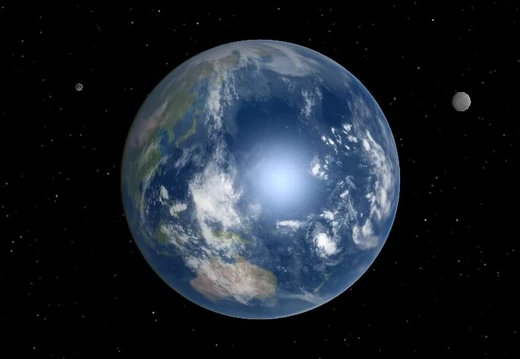
Coatlicue (star)
Hypothetical massive star that may have birthed the Sun.

Wikipedia / Wikimedia Commons
Coatlicue is a hypothetical star that may have triggered the Sun's formation before exploding as a supernova, scattering short-lived radioisotopes throughout the early Solar System. This star would have been at least thirty times the Sun's mass. While still on the main sequence, its powerful winds would have compressed the surrounding nebula's gas and dust, giving rise to hundreds of stars—including the Sun. The idea of Coatlicue was proposed to account for aluminium-26 found in meteorites, material that could have been carried outward by the massive star's winds. The name, which is unofficial, comes from the Aztec mother of the Sun, and was suggested by astronomers Matthieu Gounelle and Georges Meynet in an article for *Astronomy & Astrophysics*.
- mass
- at least 30 times the mass of the Sun
- proposed_by
- Matthieu Gounelle and Georges Meynet
- published_in
- Astronomy & Astrophysics
- named_after
- Cōātlīcue, the Aztec mother of the Sun
- status
- hypothetical star
Lore & Background
Coatlicue is a hypothetical star proposed to have induced the formation of the Sun, then exploded as a supernova, seeding the Solar System with short-lived radioisotopes. It would have been at least thirty times the mass of the Sun, and while on the main sequence, its strong winds would have compressed the dust and gas of the local nebula and given birth to hundreds of stars, including the Sun.
Reader's Guide
The concept of Coatlicue addresses a key puzzle in solar system formation: the presence of short-lived radioisotopes like aluminium-26 in meteorites. These isotopes decay quickly on cosmic timescales, so their presence suggests they were injected into the nascent solar nebula shortly before the Sun formed. The proposed massive star would have expelled such isotopes in its winds before exploding. While the name is unofficial, it was introduced by Matthieu Gounelle and Georges Meynet in an article in Astronomy & Astrophysics. The hypothesis remains one of several competing models for the Sun's birth environment, alongside triggers from low-mass supernovae or asymptotic giant branch stars. Its significance lies in linking stellar evolution, nucleosynthesis, and the origin of the Solar System.
Did You Know?
- Coatlicue is named after the Aztec mother of the Sun.
- The star would have been at least thirty times the mass of the Sun.
- Its strong winds would have compressed dust and gas to form hundreds of stars, including the Sun.
- The name is unofficial and was proposed by Matthieu Gounelle and Georges Meynet.
The Epistemological Status of Coatlicue
Coatlicue occupies a peculiar position in astronomical discourse: it is a star, or a type of star, whose existence rests entirely on speculation rather than on any definitive observational confirmation. Unlike the millions of stellar objects catalogued through telescopic surveys, Coatlicue has never been directly detected or measured. Its status is that of a conjecture—a reasoned hypothesis that a stellar object of this particular kind should exist, even though no instrument has yet captured its light, resolved its spectrum, or pinned down its coordinates. This places it firmly in the realm of the hypothetical, where the boundaries of what we know meet the outer edges of what our theoretical frameworks suggest is possible. The designation does not imply fraudulence or error; rather, it marks an honest acknowledgment that the evidence, while suggestive, has not crossed the threshold into definitive observation. Coatlicue thus stands as a reminder that the night sky, for all its apparent completeness, still harbors categories of objects we can only infer from the mathematics governing them.
Temporal Flexibility in Stellar Speculation
One of the most striking aspects of Coatlicue's classification is the temporal latitude afforded to hypothetical stars. The category is not confined to objects that might exist in the present epoch. A hypothetical star such as Coatlicue can be conjectured to have existed in the deep past, to be present but undetected, or to emerge in some distant future configuration of the universe. This three-directional temporal scope means that the label 'hypothetical' is not a statement about when the object lives, but about whether we have the observational means to confirm it. A star that burned its fuel in the first billion years of cosmic history and left no surviving signature could carry the same epistemic weight as one predicted to form under conditions that have not yet arisen. For Coatlicue specifically, this means its 'existence' is a question of theoretical consistency and predictive power rather than a matter of pointing a telescope at a particular patch of sky and recording a flux. The star is as much a statement about the laws governing stellar physics as it is about a physical object in space.
Theoretical Anchors and the Boson-Star Connection
The intellectual scaffolding supporting hypothetical stars like Coatlicue draws heavily on advanced theoretical physics, particularly the intersection of general relativity and quantum field theory. A notable strand of this work is the study of boson stars—compact objects held together by self-gravity rather than by the degeneracy pressure that supports white dwarfs or the nuclear forces that sustain main-sequence stars. The 2003 review by Schunck and Mielke in Classical and Quantum Gravity laid out the general-relativistic framework for such objects, demonstrating that under certain field configurations, stable stellar-mass entities can form without any baryonic matter. While Coatlicue is not necessarily a boson star, it belongs to the same broad family of scientifically speculated hypothetical types that push beyond the standard hydrogen-helium fusion paradigm. The existence of a rigorous mathematical literature for these objects lends credibility to the speculation: even without a photon detected, the equations permit a solution, and that solution is what gives Coatlicue its standing in the catalogue of the theoretically possible.
A Young Taxonomy of the Unobserved
Coatlicue is one entry in what is still a sparsely populated taxonomy. The broader category of hypothetical stars is divided into scientifically speculated types and specific named objects, yet both lists remain strikingly short, reflecting how young and how difficult this field of inquiry is. The emptiness of those catalogues is not a sign of failure but of the extraordinary difficulty of confirming an object that, by definition, resists direct observation. Coatlicue therefore sits alongside a small handful of other specific hypothetical stars, each representing a distinct theoretical proposal that has not yet been validated by empirical data. The category also overlaps with the wider notion of a hypothetical astronomical object, a term that encompasses not just stars but any celestial body whose existence is inferred rather than measured. For Coatlicue, this means its identity is provisional, contingent on future theoretical developments or, ideally, on an observational breakthrough that would collapse the gap between conjecture and confirmation and move it from the speculative register into the observed one.
Frequently Asked Questions
What is Coatlicue (star)?
Coatlicue is a hypothetical massive star—estimated at no less than thirty solar masses—that may have triggered the Sun's formation and then exploded as a supernova, seeding the early Solar System with short-lived radioisotopes.
Who proposed the Coatlicue hypothesis?
The idea was put forward by Matthieu Gounelle and Georges Meynet in a paper published in Astronomy & Astrophysics.
How would Coatlicue have triggered the Sun's birth?
While still burning on the main sequence, its intense stellar winds would have compressed the surrounding molecular cloud, prompting gravitational collapse that produced hundreds of stars, the Sun among them.
What evidence points to Coatlicue's existence?
Meteorites contain aluminium-26, a short-lived isotope whose abundance is difficult to explain without a nearby massive star whose winds could have scattered the material outward before a supernova dispersed it further.
Why is the star named Coatlicue?
The unofficial name is a nod to Cōātlīcue, the Aztec goddess regarded as the mother of the Sun, mirroring the hypothesis that this massive star effectively gave birth to our own.
More in Hypothetical astronomical objects 1-24
Spotted an error? Know more?
This is a living reference — every entry is fact-audited, and reader corrections feed straight into our audit queue. Suggest an edit · See this site's audit record