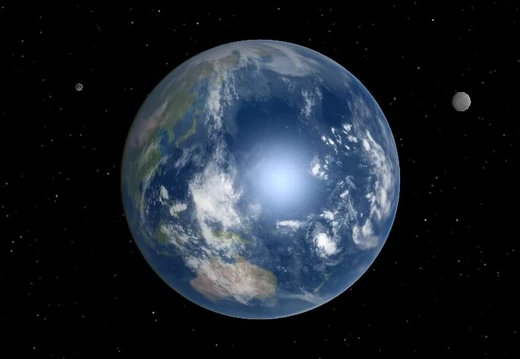
Fifth Giant
Hypothetical ice giant ejected from the early Solar System.
The Fifth Giant is a hypothetical ice giant from the five-planet Nice model, which expands on the standard Nice model of Solar System evolution. According to this idea, the early Solar System held a fifth giant planet alongside the four known ones: Jupiter, Saturn, Uranus, and Neptune. This planet is thought to have been flung out of the Solar System by gravitational forces during a chaotic migration period roughly 4 billion years ago.
The Nice model, developed in the early 2000s, explains how the giant planets moved after the protoplanetary disk faded. It suggests they started in a tighter arrangement and shifted to their current orbits by interacting with a large disk of planetesimals. These interactions sparked orbital instability, scattering the planetesimal disk and leading to the capture of irregular moons. Researchers added a fifth giant planet to the model to fix mismatches between its predictions and real observations, especially concerning the outer planets' orbits and the Kuiper belt.
This Fifth Giant would have been an ice giant, much like Uranus and Neptune in composition, with a mass between 10 and 20 Earth masses. Its initial orbit likely lay between Saturn and Uranus. Computer simulations show such a planet could have shaped the outer planets' orbits and created the observed gaps in the Kuiper belt.
The ejection probably happened during the early Solar System's unstable period, when gravitational interactions among the giant planets grew chaotic. The Fifth Giant likely had close encounters with Jupiter or Saturn, leading to its expulsion. This event would have left the remaining planets' orbits mostly intact while matching their current arrangement. The ejection might also have scattered planetesimals to form the Oort cloud or altered comet and asteroid paths.
Direct evidence for the Fifth Giant is missing, since it would have been thrown into interstellar space and is no longer bound to the Sun. But indirect clues support the idea: the current orbital spacing and resonances among the giant planets fit simulations with an extra planet; the Kuiper belt's structure and trans-Neptunian object distribution match models including a fifth giant; and the capture of irregular moons around Jupiter, Saturn, Uranus, and Neptune aligns with the chaos predicted during the ejection.
This concept differs from Planet Nine, a hypothetical planet proposed
- type
- Hypothetical ice giant
- mass
- 10 to 20 Earth masses
- composition
- Similar to Uranus and Neptune
- initial orbit
- Between Saturn and Uranus
- fate
- Ejected from the Solar System
- proposed in
- Five-planet Nice model
Lore & Background
The Fifth Giant is a hypothetical planet introduced as part of the five-planet Nice model, an extension of the Nice model of Solar System evolution. The Nice model, developed in the early 2000s, describes the dynamical evolution of the Solar System after the dissipation of the protoplanetary disk, positing that the giant planets initially formed in a more compact configuration and migrated to their current orbits due to interactions with a massive disk of planetesimals. The addition of a fifth giant planet arose as researchers attempted to resolve discrepancies between the Nice Model's predictions and observational data, particularly regarding the current orbital distribution of the outer planets and the Kuiper belt.
The Fifth Giant is hypothesized to have been an ice giant, similar in composition to Uranus and Neptune, with a mass between 10 and 20 Earth masses and an orbit initially located between those of Saturn and Uranus. Computer simulations indicate that such a planet could have influenced the dynamical evolution of the Solar System, shaping the orbits of the outer planets and accounting for observed gaps in the Kuiper belt. The ejection of the Fifth Giant is believed to have occurred during the early Solar System's period of instability, when gravitational interactions between the giant planets became chaotic, likely involving close encounters with Jupiter or Saturn.
Direct evidence for the Fifth Giant's existence is lacking, as the planet would have been ejected into interstellar space and is no longer gravitationally bound to the Sun. However, indirect evidence includes that the current orbital spacing and resonances among the giant planets are better explained in simulations that include an additional giant planet, and that the sculpting of the Kuiper belt and distribution of trans-Neptunian objects are more consistent with models involving a fifth giant planet. The capture of irregular moons around Jupiter, Saturn, Uranus, and Neptune also aligns with the chaotic conditions predicted during the Fifth Giant's ejection.
Reader's Guide
The Fifth Giant hypothesis is significant as an extension of the Nice model, offering a potential resolution to discrepancies between that model's predictions and observed Solar System features. By proposing an additional ice giant that was later ejected, the hypothesis helps explain the current orbital spacing and resonances among the giant planets, as well as the structure of the Kuiper belt and the distribution of trans-Neptunian objects. The ejection process may have also played a role in scattering planetesimals to form the Oort cloud or altering the trajectories of comets and asteroids. While direct evidence is absent—since the planet would now be in interstellar space—the indirect evidence from computer simulations and orbital dynamics lends support. The concept is distinct from Planet Nine, which is theorized to remain within the Solar System. The Fifth Giant remains a key theoretical tool for understanding the early dynamical evolution of the Solar System and the processes that shaped its current architecture.
Did You Know?
- The Fifth Giant is hypothesized to have had a mass between 10 and 20 Earth masses.
- It is theorized to have been ejected from the Solar System approximately 4 billion years ago.
- The ejection likely involved close gravitational encounters with Jupiter or Saturn.
- The Fifth Giant is distinct from Planet Nine, which is theorized to remain within the Solar System.
Architectural Position Among the Giant Planets
The Fifth Giant occupies a speculative slot in the outer Solar System's architecture. In this model, it would have been a fifth member of the giant planet family, holding a position in its original orbit between Saturn and Uranus. This placement is significant because it suggests the early Solar System may have possessed one more massive world than we currently observe. The concept fits within a long tradition of astronomers proposing additional planets to explain gaps or anomalies in the known planetary arrangement. Unlike some earlier hypothetical bodies—such as Phaeton between Mars and Jupiter, or Vulcan inside Mercury's orbit—the Fifth Giant is situated among the already-confirmed gas giants, making its proposed existence a matter of dynamical history rather than an attempt to fill an empty gap. The idea that a planet of this scale once resided in that region and was subsequently lost adds a layer of complexity to how we understand the formation and evolution of the outer planetary system.
The Ejection Event and Its Cascading Consequences
The central dramatic event in the Fifth Giant hypothesis is its violent departure from the Solar System. According to the model, a close gravitational encounter with Jupiter sent the fifth giant hurtling out into interstellar space. This single interaction did not merely remove a planet; it triggered a cascade of orbital consequences. Jupiter's and Saturn's own orbits underwent a rapid divergence as a direct result of the encounter, and this reconfiguration is thought to have been crucial in locking in the long-term orbital stability of the inner terrestrial planets. Without that divergence, the inner Solar System might have remained dynamically chaotic. Additionally, the ejection event may have been the trigger behind the Late Heavy Bombardment, a period of intense impact activity that reshaped the surfaces of the inner planets. Thus, a single gravitational slingshot could explain both the current architecture of the outer giants and a formative violence in the inner system's past.
The Possible Identity with Planet Nine
One of the most intriguing aspects of the Fifth Giant concept is its potential overlap with the currently debated Planet Nine. In this interpretation, the fifth giant was not fully lost to interstellar space but instead remained gravitationally bound to the Solar System. Two mechanisms are proposed for how it could have stayed: the gravitational influence of a nearby star, or drag forces from the gaseous remnants still present in the early Solar nebula. Either of these effects would have served to reduce the eccentricity of the planet's orbit, pulling it back into a configuration where it could persist at great distance from the Sun. This connection bridges two separate lines of speculation—the dynamical history of the giant planets and the statistical anomalies in trans-Neptunian object orbits—into a single narrative. If correct, the same body that reshaped the inner Solar System billions of years ago might still be out there, undetected, in a wide and eccentric path.
Place in the Broader Tradition of Hypothetical Worlds
The Fifth Giant belongs to a long and sometimes frustrating catalogue of proposed planets that never materialized. From Vulcan, whose supposed perturbations in Mercury's orbit were ultimately explained by Einstein's general relativity, to Tyche, ruled out by the WISE telescope survey in 2014, the history of hypothetical planets is one of bold conjecture followed by careful disproof. The Fifth Giant shares this lineage but distinguishes itself by being grounded in a coherent dynamical scenario rather than a single unexplained perturbation. It also echoes older ideas like Phaeton, a destroyed world between Mars and Jupiter, in the sense that it invokes a planet that no longer exists in its original form. Yet unlike Phaeton, whose hypothesis was undermined by the asteroid belt's insufficient mass, the Fifth Giant's absence is explained by ejection rather than destruction. It remains a live hypothesis, contingent on whether the dynamical evidence for a fifth giant's past influence can be confirmed.
Gallery


Frequently Asked Questions
What is the Fifth Giant?
The Fifth Giant is a hypothetical ice-giant planet that, in the five-planet Nice model, once orbited alongside Jupiter, Saturn, Uranus, and Neptune in the early Solar System. It is not an observed body but a theoretical addition used to explain certain dynamical outcomes of planetary migration.
How big is the Fifth Giant and what is it made of?
It is estimated at roughly 10 to 20 Earth masses, firmly in the ice-giant range. Its makeup is expected to resemble that of Uranus and Neptune—dominated by ices and rock rather than the hydrogen-helium bulk of Jupiter and Saturn.
Where did the Fifth Giant sit in the early Solar System?
The model places it in an orbit between Saturn and Uranus, part of a tighter initial cluster of all five giants. That compact arrangement existed before the protoplanetary gas disk dissipated and triggered the migration chaos.
What happened to the Fifth Giant?
It was gravitationally slung out of the Solar System during a chaotic migration episode roughly four billion years ago. Its ejection is a pivotal step in the model that ultimately reshaped the orbital spacing of the four surviving giants.
Where does the Fifth Giant idea come from?
It was introduced in the early 2000s as an extension of the original Nice model, which sought to explain how the giant planets shifted from a compact configuration to their present-day orbits. Adding a fifth body helps the model account for certain observed dynamical signatures that four planets alone struggle to reproduce.
More in Hypothetical astronomical objects 1-24
Spotted an error? Know more?
This is a living reference — every entry is fact-audited, and reader corrections feed straight into our audit queue. Suggest an edit · See this site's audit record