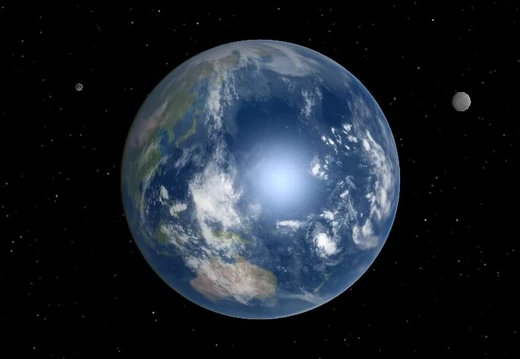
Claimed moons of Earth
Historical claims of additional Earth moons remain unconfirmed.

Wikipedia / Wikimedia Commons
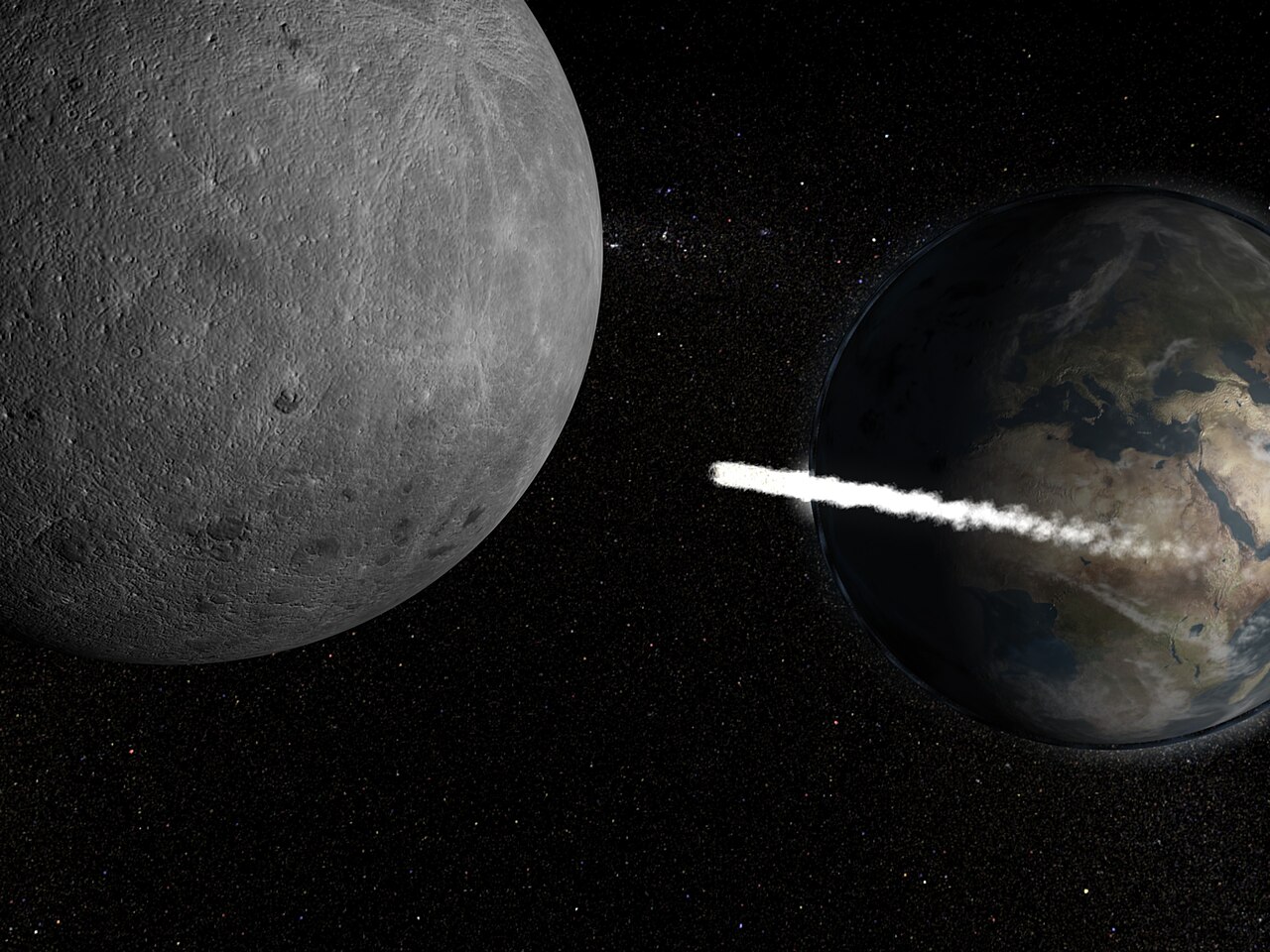
Claims of the existence of other moons of Earth—natural satellites with relatively stable orbits other than the Moon—have been made since the 19th century. Several candidates have been proposed, but none have been confirmed. The possibility has also been the subject of dubious non-scientific speculations and likely hoaxes.
- first major claim
- 1846 by Frédéric Petit
- notable claimant
- Georg Waltemath (1898)
- field
- Astronomy / Planetary science
- known for
- Proposed second moons of Earth, later discredited
- modern status
- No confirmed additional moons; temporary satellites and quasi-satellites exist
Lore & Background
The first major claim of another moon of Earth was made by French astronomer Frédéric Petit, director of the Toulouse Observatory, who in 1846 announced he had discovered a second moon in an elliptical orbit around Earth. It was claimed to have also been reported by Lebon and Dassier at Toulouse, and by Larivière at Artenac Observatory, during the early evening of March 21, 1846. Petit proposed that this second moon had an elliptical orbit, a period of 2 hours 44 minutes, with 3,570 km apogee and a perigee altitude of just 11.4 km above Earth's surface—an altitude physically impossible as it would lie deep within the atmosphere. This claim was soon dismissed by his peers. Petit published another paper on his 1846 observations in 1861, basing the second moon's existence on perturbations in movements of the actual Moon. This second moon hypothesis was not confirmed either.
Reader's Guide
In 1898, Hamburg scientist Dr. Georg Waltemath announced that he had located a system of tiny moons orbiting Earth. He described one proposed moon as being 1,030,000 km from Earth, with a diameter of 700 km, a 119-day orbital period, and a 177-day synodic period. He also said it did not reflect enough sunlight to be observed without a telescope, unless viewed at certain times. E. Stone Wiggins, a Canadian weather expert, ascribed the cold spring of 1907 to the effect of a second moon, which he said he had first seen in 1882. The existence of these objects was discredited after the absence of corroborating observation by other members of the scientific community. Especially problematic was a failed prediction that they would be seen in February 1898. Later claims included those by astrologer Walter Gorn Old in 1918, who named a dark moon Lilith, and by amateur German astronomer W. Spill in 1926. In the late 1960s, John Bagby claimed to have observed over ten small natural satellites of Earth, but this was not confirmed. General surveys by William Henry Pickering by 1903 and Clyde Tombaugh in the 1950s ruled out many types of objects. As of 2024, the only confirmed temporary natural satellites have been 2006 RH120, 2020 CD3, and 2024 PT5.
Did You Know?
- Petit's proposed moon had a perigee altitude of only 11.4 km above the surface—inside the atmosphere and far lower than any stable orbit.
- Waltemath's moon was predicted to have a 119-day orbital period and a 177-day synodic period.
- Clyde Tombaugh's four-year search for natural satellites in the 1950s was unsuccessful.
- As of 2024, several temporary natural satellites have been confirmed, including 2006 RH120, 2020 CD3, 2024 PT5, 1991 VG, and 2022 NX1, though some are disputed or classified differently.
The 19th-Century Claims and Their Rapid Demise
The search for a hidden companion to our Moon has a long and largely embarrassing history. In 1846, Frédéric Petit, who directed the Toulouse Observatory, declared that he and several colleagues had spotted a second satellite tracing an elliptical path around Earth. He assigned it a period of just under three hours and a perigee of roughly 11.4 kilometres—essentially the cruising altitude of a modern jet airliner, deep inside the atmosphere. Fellow astronomers quickly rejected the claim, and Petit's follow-up paper in 1861, which leaned on supposed gravitational tugs on the real Moon, fared no better. Decades later, Hamburg scientist Georg Waltemath announced in 1898 that he had found a system of tiny moons, describing one as 700 kilometres across and 1.03 million kilometres away with a 119-day orbit. His credibility collapsed when a specific prediction for a February 1898 sighting went unfulfilled. Canadian weatherman E. Stone Wiggins added his own layer, linking a mysterious 'green crescent' glimpsed in New Zealand and North America in 1886 to a carbon-atmosphere moon he claimed to have first seen in 1882. None of these proposals survived scrutiny.
Quasi-Satellites and Earth's Orbital Neighbours
Although no true second satellite has ever been confirmed, Earth does share its solar orbit with a handful of intriguing near-Earth objects that behave in ways reminiscent of a moon. The most celebrated example is 469219 Kamoʻoalewa, identified on 27 April 2016. It circles the Sun, yet from our vantage point it appears to trace a loop around Earth, making it the most stable known quasi-satellite. It is, however, far too distant to be gravitationally bound to our planet in the way the Moon is. Asteroid 3753 Cruithne offers another variant: it seems to orbit a point in space rather than Earth itself. Then there are the Earth trojans, such as 2010 TK7, which ride the same solar orbit as Earth and appear to lead or trail it along the path. Collectively, these resonant near-Earth objects have been dubbed 'minimoons' or 'second moons,' a label that captures their quasi-lunar behaviour while making clear they are not true satellites. They remind us that the boundary between a planet's neighbourhood and open solar orbit is far blurrier than a simple gravitational tether would suggest.
Temporary Captures and the Short-Lived Moons
Beyond the speculative and the quasi-stable, there is a more concrete category of objects that genuinely become Earth's satellite, if only for a brief spell. Small bodies already orbiting the Sun can be temporarily captured by Earth's gravity, spending months or a few years in a close orbit before escaping back into heliocentric space. As of 2024, three such captures have been confirmed. The first, 2006 RH120, entered Earth's orbit in 2006 and remained there through 2007. The second, 2020 CD3, was detected in a temporary Earth orbit spanning 2018 to 2020. The most recent, 2024 PT5, was confirmed in Earth orbit during 2024. These temporary satellites are not the dramatic, permanent companions that 19th-century astronomers once dreamed of finding. Instead, they are fleeting visitors, small enough to go unnoticed for years and transient enough to vanish back into the solar system. Their discovery underscores that Earth's gravitational neighbourhood is more dynamic and more populated than the single, ancient Moon would suggest, even if those extra residents are only passing through.
Systematic Searches, Military Involvement, and the Pseudoscientific Afterlife
The quest for a hidden second moon has drawn in serious astronomers, military institutions, and pseudoscience in turn. William Henry Pickering, who had proposed that the Moon once broke free from Earth, conducted a systematic survey by 1903 that ruled out many classes of potential satellites. His 1923 paper in Popular Astronomy, titled 'A Meteoric Satellite,' further stimulated amateur astronomers to scan the skies for small companions. In 1954, the U.S. Army's Office of Ordnance Research enlisted Clyde Tombaugh—the man who had found Pluto—to search for near-Earth asteroids, and the Pentagon issued a public explanation for the effort. Yet Donald Keyhoe, later head of the UFO research group NICAP, claimed a Pentagon source told him the real trigger was two objects detected on new long-range radar in mid-1953, and he asserted in May 1954 that the search had already succeeded. A general reportedly asked whether the finds were natural or artificial. Tombaugh denied the story. Meanwhile, astrologer Sepharial named a supposed dark moon 'Lilith' in 1918, and amateur W. Spill published a sighting claim in the German journal Die Sterne in 1926—reminders that the legend of Earth's lost companion continues to outlive every failed search.
Gallery


Frequently Asked Questions
Who first claimed a second moon of Earth?
The earliest well-known proposal came from Frédéric Petit in 1846, when he reported observing a small companion body near the Moon. His claim was never independently verified and quickly fell out of favor.
Are there any confirmed additional moons orbiting Earth?
No natural satellite beyond the Moon has ever been confirmed. Modern astronomy does recognize temporary captured objects and quasi-satellites that briefly share Earth's orbit, but none qualify as a stable second moon.
Who is Georg Waltemath in the context of Earth's claimed moons?
Waltemath was a German observer who, in 1898, announced the discovery of a small companion body he called a second Earth moon. His claim, like most others in this line of speculation, was never substantiated by other astronomers.
Why do 'Claimed moons of Earth' still come up in fan and hobbyist discussions?
They serve as a cautionary chapter in observational history, showing how limited instruments and human pattern-recognition can produce convincing but false detections. The topic also intersects with hoaxes and non-scientific speculation, which keeps it popular in enthusiast circles.
What is the final scientific verdict on Earth's second moon?
The consensus in planetary science is that no additional stable natural satellite exists. The field has moved on to studying genuinely transient objects like temporary captured asteroids, while the older claims remain firmly in the discredited category.
More in Hypothetical astronomical objects 1-24
Spotted an error? Know more?
This is a living reference — every entry is fact-audited, and reader corrections feed straight into our audit queue. Suggest an edit · See this site's audit record