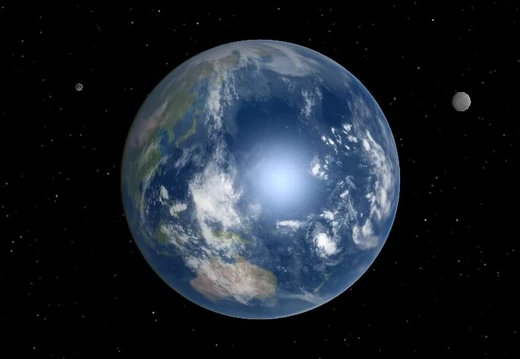
Galaxy X (galaxy)
A hypothesized dark dwarf galaxy behind the Milky Way's disk.
Galaxy X is a hypothetical dark satellite dwarf galaxy that may orbit the Milky Way. If real, it would consist mostly of dark matter and interstellar gas, with very few stars. It is thought to lie roughly 90 kiloparsecs (290,000 light-years) from the Sun, hidden behind the Milky Way’s disk, and spans about 12 kiloparsecs (39,000 light-years) across. Its proposed galactic coordinates are l = -27.4°, b = -1.08°.
Evidence for Galaxy X was first presented in 2015, when Sukanya Chakrabarti and her team claimed to have found four Cepheid variable stars. The search for these stars was inspired by an earlier study linking a warp in the Milky Way’s atomic hydrogen disk to the gravitational pull of an unseen galaxy. That study estimated the perturber’s mass at about 1% of the Milky Way’s mass, making it the third most massive satellite after the Large and Small Magellanic Clouds (each about ten times larger). In this scenario, the galaxy would have interacted with the Milky Way roughly 600 million years ago, passing as close as 5 to 10 kiloparsecs (16,000 to 33,000 light-years), and is now moving away.
The name “Galaxy X” was introduced in 2011, modeled after the term “Planet X.”
The existence of Galaxy X is disputed. In November 2015, a team led by P. Pietrukowicz argued against it, claiming the four stars were not true Cepheid variables and that their distances likely differed from those reported by Chakrabarti’s group. They concluded there was no evidence for a background dwarf galaxy. Nonetheless, some researchers still consider the galaxy plausible, maintaining that the stars are indeed Cepheids.
- type
- Postulated dwarf galaxy
- proposed_distance
- 90 kpc (290 kly) from the Sun
- proposed_size
- 12 kpc (39 kly) in extent
- proposed_mass
- About 1% of the Milky Way's mass
- discovery_claim
- 2015, based on four Cepheid variable stars
- name_coined
- 2011, in analogy to Planet X
Lore & Background
Observational evidence for Galaxy X was presented in 2015, based on the claimed discovery of four Cepheid variable stars by Sukanya Chakrabarti (RIT) and collaborators. The search for these stars was motivated by an earlier study that linked a warp in the HI (atomic hydrogen) disk of the Milky Way Galaxy to the tidal effects of a perturbing galaxy. The unseen perturber's mass was calculated to be about 1% of that of the Milky Way, which would make it the third heaviest satellite of the Milky Way, after the Magellanic Clouds (Large Magellanic Cloud and Small Magellanic Cloud, each some 10x larger than Galaxy X). In this hypothetical model, the putative satellite galaxy would have interacted with the Milky Way some 600 million years ago, coming as close as 5–10 kpc (16–33 kly), and would now be moving away from the Milky Way.
Reader's Guide
Galaxy X represents a significant but controversial candidate in the study of Milky Way satellite galaxies. Its existence was proposed to explain a warp in the Milky Way's atomic hydrogen disk, attributed to tidal effects from a dark subhalo. If real, it would be the third most massive satellite of the Milky Way, after the Magellanic Clouds, and would consist mostly of dark matter and gas with few stars. The 2015 claim of four Cepheid variable stars as evidence was met with skepticism: a group led by P. Pietrukowicz argued in November 2015 that the stars were not actually Cepheids and that their distances might be very different, concluding 'there is no evidence for a background dwarf galaxy.' However, the galaxy is still regarded to exist by others, with the stars being examined to be actual Cepheids. This ongoing dispute highlights the challenges of detecting dark-matter-dominated galaxies behind the Milky Way's disk and the importance of variable star classification in galactic astronomy.
Did You Know?
- Galaxy X was named in 2011 in analogy to Planet X.
- If it exists, it would be composed mostly of dark matter and interstellar gas with few stars.
- Its proposed mass is about 1% of the Milky Way's mass, making it the third heaviest satellite after the Magellanic Clouds.
- A 2015 paper by P. Pietrukowicz argued that the four claimed Cepheid stars were not actually Cepheids.
More in Hypothetical astronomical objects 1-24
Spotted an error? Know more?
This is a living reference — every entry is fact-audited, and reader corrections feed straight into our audit queue. Suggest an edit · See this site's audit record