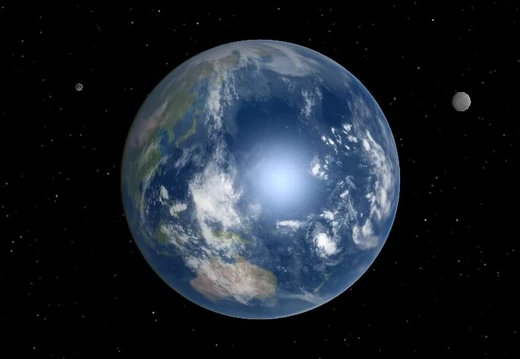
Hycean planet
Hypothetical planets with hydrogen atmospheres and liquid water oceans.
A hycean planet (pronounced HY-shən) is a hypothetical world covered by liquid-water oceans and wrapped in a hydrogen-rich atmosphere. The name combines "hydrogen" and "ocean." Because they hold extraterrestrial liquid water, these planets are seen as strong candidates for supporting life. They are generally larger and more massive than Earth. As of 2023, none have been confirmed, though the Kepler mission found many possible examples.
The term was coined in 2021 by a Cambridge team led by Nikku Madhusudhan, first appearing in *The Astrophysical Journal* on August 31, 2021. Hycean planets are thought to be common around red dwarf stars and are considered promising targets in the search for life beyond Earth. Any life there would likely be entirely aquatic. Their water-rich makeup allows them to be larger than non-hycean planets, making them easier to observe and to search for biosignatures. Candidate worlds like K2-18b have been studied by ground-based telescopes and the James Webb Space Telescope. Whether such planets can actually form with enough water remains debated. Recent work suggests habitable zones may be more complex and smaller than once thought, with tidal heating possibly playing a key role. K2-18b has drawn attention due to possible biosignatures detected in its atmosphere.
Hycean planets can be much larger than earlier estimates for habitable worlds, with radii up to 2.6 Earth radii and masses up to 10 Earth masses. Their habitable zones may also be much wider than those of Earth-like planets. Equilibrium temperatures can reach 430 K (157 °C) for planets orbiting late M-dwarfs. However, mass and radius alone do not reveal a planet’s composition—two bodies with the same mass and radius could be either a hycean planet or a super-Earth.
These planets can have many different atmospheric compositions and internal structures. Some may be tidally locked "dark hycean" worlds, where only the permanent night side is habitable. Others could be "cold hycean" planets, kept warm by a greenhouse effect even with very little starlight, possibly including rogue planets without a star. Dark hycean worlds are more likely around low-mass stars like M-dwarfs, forming when the atmosphere fails to redistribute heat from the day side to the night side. For hotter stars, the dark hycean habitable zone may lie beyond the tidal-locking distance.
Habitability may be
- coined
- 2021
- coined_by
- Nikku Madhusudhan and team at the University of Cambridge
- first_published
- The Astrophysical Journal, August 31, 2021
- type
- Hypothetical exoplanet
- key_trait
- Hydrogen-rich atmosphere over liquid water ocean
- typical_size
- Up to 2.6 R🜨 and 10 M🜨
Lore & Background
The term 'hycean planet' was coined in 2021 by a team led by Nikku Madhusudhan at the University of Cambridge, combining 'hydrogen' and 'ocean.' The concept was introduced in a paper published in The Astrophysical Journal on August 31, 2021. Hycean planets are thought to be larger and more massive than Earth, with radii reaching 2.6 R🜨 and masses up to 10 M🜨. Their water-rich compositions may make them easier to observe and detect biosignatures.
Reader's Guide
Hycean planets represent a significant shift in the search for extraterrestrial life, as their habitable zones may be larger than those of Earth-like planets, extending to 1.5 AU for M dwarfs and 10 AU for G dwarfs. Candidate worlds like K2-18b have been investigated for biosignatures using telescopes such as the James Webb Space Telescope. However, their habitability is debated: many candidates lie in regions where oceans would boil, and runaway greenhouse effects or water loss from stellar radiation may limit life. Tidal heating and orbital eccentricity further complicate habitable zone models. Despite uncertainties, hycean planets remain a focal point for future observations by TESS and JWST, with organosulfur compounds like dimethylsulfide proposed as potential biosignatures in hydrogen-rich atmospheres.
Did You Know?
- The term 'hycean' is a portmanteau of 'hydrogen' and 'ocean.'
- Hycean planets are thought to be common around red dwarf stars.
- Candidate hycean planet K2-18b has been investigated for biosignatures by the James Webb Space Telescope.
- Dark hycean planets may be habitable only on their permanent nightside due to tidal locking.
More in Hypothetical astronomical objects 1-24
Spotted an error? Know more?
This is a living reference — every entry is fact-audited, and reader corrections feed straight into our audit queue. Suggest an edit · See this site's audit record