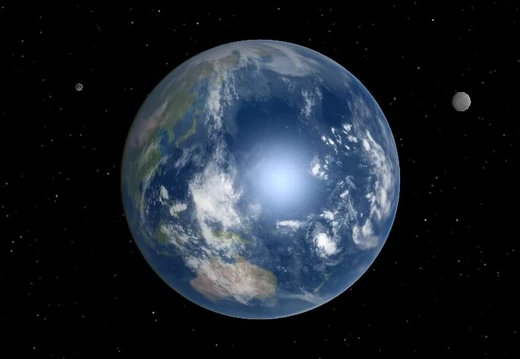
Multiverse
Hypothetical set of all universes, debated in science and philosophy.
The multiverse is a hypothetical collection encompassing all universes. This set is thought to include everything that exists: all of space, time, matter, energy, information, and the physical laws and constants governing them. Within this framework, individual universes go by many names, such as parallel, flat, alternate, or many worlds. A common view describes the multiverse as a patchwork of separate universes, all operating under the same physical laws.
The idea of multiple universes has a long history, appearing in fields like cosmology, physics, and philosophy. Some physicists consider it a philosophical concept rather than a scientific one, because it cannot be empirically falsified. In recent years, both supporters and skeptics have emerged within the physics community. While some scientists have searched for evidence of other universes, no statistically significant finding has been made. Critics point out that the multiverse lacks testability and falsifiability—key requirements for scientific inquiry—and raises unresolved metaphysical issues.
Max Tegmark and Brian Greene have each developed classification systems for multiverses. Tegmark’s four levels are: Level I (an extension of our universe), Level II (universes with different physical constants), Level III (the many-worlds interpretation of quantum mechanics), and Level IV (the ultimate ensemble). Greene’s nine types include quilted, inflationary, brane, cyclic, landscape, quantum, holographic, simulated, and ultimate. These ideas explore various dimensions, physical laws, and mathematical structures to explain how multiple universes might exist and interact. Other multiverse concepts include twin-world models, cyclic theories, M-theory, and black-hole cosmology.
The anthropic principle suggests that a multitude of universes, each with different laws, could explain why our universe appears fine-tuned for conscious life. The weak anthropic principle holds that we exist in one of the few universes that can support life. Debates about Occam’s razor arise, with proponents like Max Tegmark arguing that the multiverse is simpler and more elegant than a single universe. The many-worlds interpretation and modal realism—the idea that all possible worlds are as real as our own—are also discussed in this context.
**History of the concept**
**Antecedents** Some trace the idea of infinite worlds to the
- field
- Cosmology, physics, philosophy
- known_for
- Hypothetical set of all universes; subject of classification schemes by Max Tegmark and Brian Greene
- key_proponents
- Lee Smolin, Don Page, Brian Greene, Max Tegmark, Alan Guth, Andrei Linde, Michio Kaku, David Deutsch, Leonard Susskind, Alexander Vilenkin, Yasunori Nomura, Raj Pathria, Laura Mersini-Houghton, Neil d
- key_skeptics
- Sabine Hossenfelder, David Gross, Paul Steinhardt, Anna Ijjas, Abraham Loeb, David Spergel, Neil Turok, Viatcheslav Mukhanov, Michael S. Turner, Roger Penrose, George Ellis, Joe Silk, Carlo Rovelli, A
Lore & Background
The idea of multiple worlds was first suggested by the pre-Socratic Greek philosopher Anaximander in the sixth century BCE, though debate exists whether he believed in co-existent or successive worlds. Ancient Indian thinkers, both Hindu and Buddhist, postulated multiple realms. The first figures definitively attributed with the concept of innumerable worlds are the Ancient Greek Atomists Leucippus and Democritus in the 5th century BCE, followed by Epicurus and the Roman Epicurean Lucretius. In the third century BCE, Chrysippus suggested the world eternally expired and regenerated, implying multiple universes across time. Giordano Bruno expressed the concept of infinite worlds in the Renaissance.
Reader's Guide
The multiverse concept has evolved from ancient philosophical speculation to modern scientific debate. In 1895, William James used the term 'multiverse' in a different context, and the concept appeared in modern science during the Boltzmann–Zermelo debate. Erwin Schrödinger in 1952 described quantum superposition as histories that 'all really happen simultaneously.' Max Tegmark and Brian Greene proposed classification schemes: Tegmark's four levels (extension of our universe, universes with different physical constants, many-worlds interpretation, ultimate ensemble) and Greene's nine types (quilted, inflationary, brane, cyclic, landscape, quantum, holographic, simulated, ultimate). The anthropic principle suggests a multitude of universes could explain the fine-tuning of our universe for conscious life. Critics argue the multiverse lacks testability and falsifiability, with Paul Davies comparing it to theological discussions requiring a leap of faith. Searches for evidence, including analysis of WMAP and Planck satellite data, have found no statistically significant evidence of other universes. A 2015 signal analyzed by Dr. Ranga-Ram Chary showed a brightness 4,500 times higher than expected, with a 30% chance of being noise, possibly indicating matter from a parallel universe, but also possibly from distant galaxies or dust clouds.
Did You Know?
- The term 'multiverse' was used by William James in 1895, but in a different context.
- Erwin Schrödinger in 1952 said his equations describing several histories were 'not alternatives, but all really happen simultaneously.'
- Max Tegmark's four-level classification includes Level I (extension of our universe) through Level IV (ultimate ensemble).
- Analysis of WMAP and Planck satellite data found no statistically significant evidence of bubble universe collisions.
More in Hypothetical astronomical objects 1-24
Spotted an error? Know more?
This is a living reference — every entry is fact-audited, and reader corrections feed straight into our audit queue. Suggest an edit · See this site's audit record