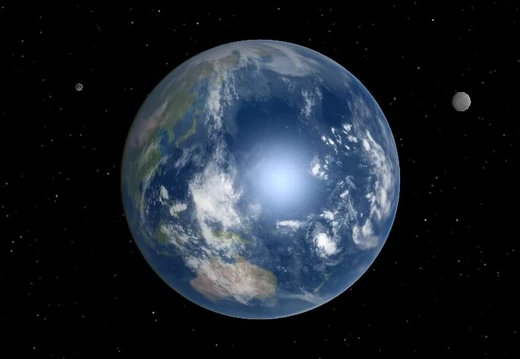
Phaeton (hypothetical planet)
Hypothetical destroyed planet proposed to explain the asteroid belt.
Phaeton (alternatively Phaethon or Phaëton) is a hypothetical planet that was proposed to have existed between the orbits of Mars and Jupiter, based on the Titius–Bode law. Its supposed destruction was thought to have formed the asteroid belt, including the dwarf planet Ceres. The hypothesis was named after Phaethon, the son of the sun god Helios in Greek mythology, who attempted to drive his father's solar chariot and was destroyed by Zeus.
- field
- Astronomy, planetary hypothesis
- known_for
- Hypothetical destroyed planet between Mars and Jupiter, linked to the asteroid belt's formation
- named_after
- Phaethon, son of Helios in Greek mythology
- first_proposed_by
- Johann Gottlieb Radlof (1823)
- key_supporters
- Heinrich Wilhelm Matthäus Olbers, Joseph-Louis Lagrange, Michael Ovenden, Donald Menzel
Lore & Background
The Phaeton hypothesis arose from the Titius–Bode law, a 1700s pattern of planetary spacing. After Ceres was discovered in 1801 at the predicted gap, and Pallas in 1802, astronomer Heinrich Wilhelm Matthäus Olbers proposed they were fragments of a disrupted planet. The discovery of Juno and Vesta further supported this idea. In 1823, Johann Gottlieb Radlof named the destroyed planet Phaëthon, linking it to Greek myths.
In 1927, Franz Xaver Kugler argued that the Phaethon myth was based on a real event: a bright celestial object around 1500 BC that fell to Earth as meteorites, causing fires and floods. Later, in 1953, Ivan I. Putilin suggested Phaeton was destroyed by centrifugal forces, with a diameter of about 6,880 kilometers. In 1955, Konstantin N. Savchenko proposed that Ceres, Pallas, Juno, and Vesta were former moons of Phaeton, with a fifth satellite colliding with the planet.
The hypothesis was supported by several scientists including Joseph-Louis Lagrange (1814), Reginald Daly (1943), Harrison Brown and Clair Patterson (1948), and Michael Ovenden (1972–1973), who suggested the planet be named "Krypton" and believed it was a gas giant of 85–90 Earth masses.
Reader's Guide
The Phaeton hypothesis was a significant attempt to explain the asteroid belt's origin, driven by the Titius–Bode law's apparent prediction of a missing planet. It influenced early 19th-century astronomy and led to the discovery of major asteroids. However, the hypothesis has been superseded by the accretion model, which holds that asteroids are remnants of the protoplanetary disk that never formed a planet due to Jupiter's gravitational perturbations. Despite this, the idea persists in some pseudoscientific and fictional contexts, such as Zecharia Sitchin's Nibiru theory and Tom Van Flandern's exploded planet hypothesis. The concept also appears in science fiction, often as a warning about nuclear destruction. Today, the Phaeton hypothesis is considered obsolete by most astronomers, but it remains a historical curiosity illustrating how patterns in data can inspire speculative theories.
Did You Know?
- The name Phaeton was first applied to the hypothetical planet by German linguist Johann Gottlieb Radlof in 1823.
- In 1927, Franz Xaver Kugler argued that the myth of Phaethon was based on a real celestial object that fell to Earth around 1500 BC.
- Michael Ovenden suggested the planet be named 'Krypton' after Superman's destroyed home world.
- The Phaeton hypothesis has been superseded by the accretion model, which states that Jupiter's gravity prevented planet formation in the asteroid belt.
More in Hypothetical astronomical objects 1-24
Spotted an error? Know more?
This is a living reference — every entry is fact-audited, and reader corrections feed straight into our audit queue. Suggest an edit · See this site's audit record