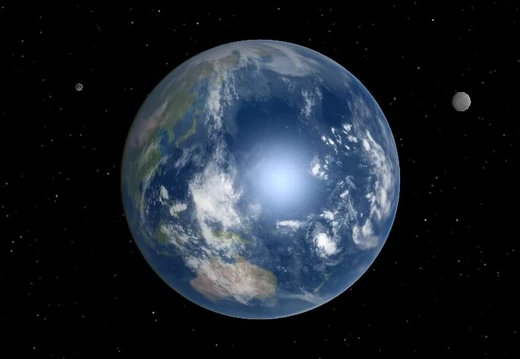
Planet Nine
Hypothetical planet proposed to explain distant Solar System orbits.
Planet Nine is a hypothetical ninth planet in the outer region of the Solar System, proposed to explain the peculiar clustering of orbits for a group of extreme trans-Neptunian objects (ETNOs). Its existence remains unconfirmed, and some astronomers attribute the observed clustering to observational biases.
- type
- Hypothetical planet
- proposed_by
- Konstantin Batygin and Michael Brown
- estimated_mass
- 5–10 Earth masses (later refined to 4.4 ± 1.1 Earth masses)
- estimated_semi-major_axis
- 400–800 AU (refined to 290±30 AU in 2025)
- estimated_orbital_period
- 10,000–20,000 years
- estimated_inclination
- 15°–25° to the ecliptic
Lore & Background
Following the discovery of Neptune in 1846, speculation about another planet beyond its orbit led to searches for Planet X, culminating in the discovery of Pluto in 1930, which was too small to fit predictions. The discovery of Sedna in 2003 and 2012 VP113 in 2014 renewed interest in a distant massive body. In 2016, Batygin and Brown described how the similar orbits of six ETNOs could be explained by a ninth planet, with an estimated mass of 5–10 Earth masses and an elongated orbit 400–800 AU from the Sun. Subsequent discoveries of objects like 2017 OF201 and 2023 KQ14 have challenged the hypothesis, as their orbits are not aligned with the other TNOs and would be unstable if Planet Nine were present. However, versions of the hypothesis exist without the need for the orbital clustering called into question by such objects.
Reader's Guide
Planet Nine represents a significant hypothesis in planetary astronomy, attempting to explain the observed clustering of extreme trans-Neptunian objects. Its proposed gravitational influence would shepherd the orbits of the most distant known Solar System objects. Despite extensive sky surveys by WISE and Pan-STARRS, the planet has not been detected, and its existence remains conjectural. The hypothesis has evolved with refined orbital estimates, from 400–800 AU to 290±30 AU in 2025, and mass estimates refined to 4.4 ± 1.1 Earth masses. Alternative explanations, such as observational biases, continue to be debated. If confirmed, Planet Nine would reshape understanding of the Solar System's outer reaches and formation history.
Did You Know?
- Planet Nine's estimated mass was refined to 4.4 ± 1.1 Earth masses in 2025 by Amir Siraj and colleagues.
- The planet's orbit was estimated to have a semi-major axis of 290±30 AU in 2025.
- Some astronomers attribute the clustering of ETNO orbits to observational biases rather than a planet.
- If Planet Nine exists, a probe could reach it in as little as 20 years using a powered slingshot trajectory around the Sun.
More in Hypothetical astronomical objects 1-24
Spotted an error? Know more?
This is a living reference — every entry is fact-audited, and reader corrections feed straight into our audit queue. Suggest an edit · See this site's audit record