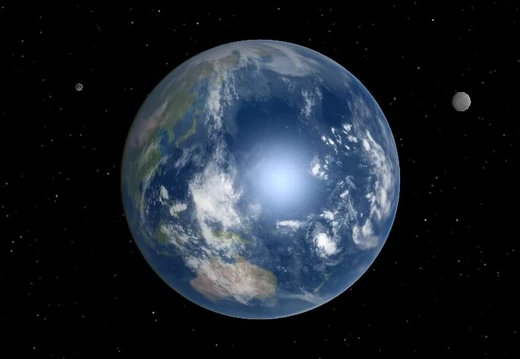
Planet V
Hypothetical fifth terrestrial planet proposed to explain the Late Heavy Bombardment.
Planet V is a hypothetical fifth rocky planet that NASA scientists John Chambers and Jack J. Lissauer proposed once orbited between Mars and the asteroid belt. In their idea, gravitational nudges from the other inner planets pushed Planet V’s path into the asteroid belt, which set off the Late Heavy Bombardment during the Hadean eon. Chambers and Lissauer first shared early results from testing this idea at the 33rd Lunar and Planetary Science Conference in March 2002.
According to the hypothesis, the early solar system formed five terrestrial planets. The fifth one started on a nearly circular orbit between Mars and the asteroid belt, with a semi-major axis between 1.8 and 1.9 AU. This orbit was stable for a long time but became unstable after about 600 million years. Eventually, interactions with the other inner planets pushed Planet V into a highly elongated orbit that cut into the inner asteroid belt. Close encounters with Planet V scattered asteroids onto Mars-crossing and resonant paths, and many of those asteroids later shifted onto Earth-crossing orbits, temporarily raising the rate of impacts on the Moon. This continued until Planet V was lost, most likely by falling into the Sun after entering the ν6 secular resonance.
As an initial test, Chambers and Lissauer ran 36 computer simulations of the solar system with an extra terrestrial planet, varying its starting orbit and mass. The average time before Planet V was lost grew from 100 million to 400 million years as its initial semi-major axis increased from 1.8 to 1.9 AU. Results that matched the current solar system were most common when Planet V had a mass of 0.25 times that of Mars. With a larger mass, collisions between planets became likely. Overall, about one-third of the simulations were considered successful because Planet V was removed without hitting another planet. To see if Planet V could boost the lunar impact rate, the researchers added test particles to one simulation. After an initial drop, the number of particles on Earth-crossing orbits rose once Planet V entered the inner asteroid belt, a pattern consistent with the Late Heavy Bombardment. These results were presented at the 33rd Lunar and Planetary Science Conference.
In a later 2007 paper in the journal *Icarus*, Chambers reported results from 96 simulations examining the orbital dynamics of a five-terrestrial-planet solar sys
- proposed_by
- John Chambers and Jack J. Lissauer
- proposed_in
- 2002
- type
- Hypothetical terrestrial planet
- location
- Between Mars and the asteroid belt (semi-major axis 1.8–1.9 AU)
- mass
- Typically 0.25 Mars mass or less
- fate
- Most likely impacted the Sun after entering the ν6 secular resonance
Lore & Background
Chambers and Lissauer hypothesized that five terrestrial planets formed in the early Solar System, with the fifth occupying a low-eccentricity orbit between Mars and the asteroid belt at a semi-major axis of 1.8 to 1.9 AU. This orbit was stable for up to 600 million years but eventually became unstable due to perturbations from the other inner planets, driving Planet V onto a high-eccentricity orbit that crossed into the inner asteroid belt. Asteroids scattered by close encounters with Planet V evolved onto Earth-crossing orbits, temporarily enhancing the lunar impact rate. Planet V was ultimately lost, most likely by impacting the Sun after entering the ν6 secular resonance.
Initial tests by Chambers and Lissauer involved 36 computer simulations with varying parameters. Results consistent with the current Solar System were most common with a Planet V mass of 0.25 Mars mass; a third of these simulations were deemed successful, with Planet V removed without impacting another planet. Test particles added to one simulation showed an increase in Earth-crossing orbits after Planet V entered the inner asteroid belt, a pattern consistent with the Late Heavy Bombardment. In 2007, Chambers reported results from 96 simulations, finding that in a quarter of cases Planet V was ejected or impacted the Sun without collisions among other planets, most frequently when its mass was less than 0.25 of Mars.
Ramon Brasser and Alessandro Morbidelli examined the hypothesis in 2011, focusing on the magnitude of bombardment required. They calculated that Planet V would need to remove 95% of the pre-LHB main asteroid belt or 98% of the inner asteroid belt, requiring it to remain in an orbit crossing the entire asteroid belt for 300 million years—an evolution not observed in simulations. In a few percent of simulations, Planet V remained in the inner belt long enough to produce the LHB, but this would require the inner asteroid belt to have begun with 4–13 times the mass of the rest. Brasser and Morbidelli also examined the possibility of Planet V disrupting putative asteroid belts between terrestrial planets, finding that a Venus-Earth belt could be 99.99% depleted in 66% of compatible simulations, but an Earth-Mars belt could not be significantly depleted due to its higher stability.
Reader's Guide
The Planet V hypothesis represents an attempt to explain the Late Heavy Bombardment, a period of intense impacts in the early Solar System, by invoking an additional terrestrial planet that destabilized the asteroid belt. While the hypothesis was initially supported by computer simulations showing that a fifth planet could be removed without disrupting the current configuration, later work by Brasser and Morbidelli raised significant challenges. They found that producing the required depletion of the asteroid belt demanded orbital evolutions not observed in simulations, and that the necessary initial mass of the inner asteroid belt would have been implausibly high. The hypothesis also faced difficulties in explaining the lack of remnants of putative asteroid belts between the terrestrial planets. Although Planet V remains a hypothetical concept, it has contributed to broader discussions of planetary dynamics and the origin of the Late Heavy Bombardment, alongside models such as the Nice model. An alternate version proposes that Planet V impacted Mars, forming the Borealis Basin, with debris producing a different size distribution of impactors.
Did You Know?
- Planet V was proposed by NASA scientists John Chambers and Jack J. Lissauer at the 33rd Lunar and Planetary Science Conference in 2002.
- In simulations, a Planet V with mass less than 0.25 of Mars most frequently resulted in ejection or solar impact without collisions among other planets.
- Brasser and Morbidelli calculated that Planet V would need to remove 95% of the pre-LHB main asteroid belt to cause the Late Heavy Bombardment.
- An alternate version suggests Planet V impacted Mars, forming the Borealis Basin, with debris having a different size distribution than the asteroid belt.
More in Hypothetical astronomical objects 1-24
Spotted an error? Know more?
This is a living reference — every entry is fact-audited, and reader corrections feed straight into our audit queue. Suggest an edit · See this site's audit record