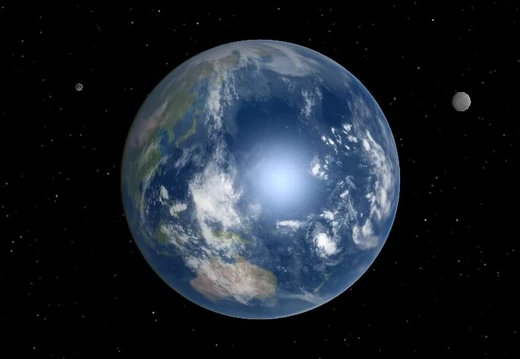
Planets beyond Neptune
Hypothetical worlds beyond Neptune, from Planet X to Planet Nine.
The concept of planets beyond Neptune has a long history, beginning with speculation shortly after Neptune's discovery in 1846. Astronomers proposed various hypothetical worlds to explain orbital discrepancies in the outer planets, culminating in the search for Planet X and the eventual discovery of Pluto in 1930. Though Pluto was later reclassified as a dwarf planet, the idea of an unseen planet in the outer Solar System persists, with modern hypotheses such as Planet Nine emerging from observed anomalies in trans-Neptunian objects.
- First proposed
- 1840s
- Key proponent
- Percival Lowell
- Notable discovery
- Pluto (1930)
- Current status
- Hypothetical (Planet Nine)
- Related classification
- Dwarf planets (2006)
- Observational limits
- No Saturn-sized object out to 10,000 AU (as of March 2014)
Lore & Background
Following the discovery of Neptune in 1846, astronomers noted residual discrepancies in the orbits of Uranus and Neptune. In 1848, Jacques Babinet proposed a planet named 'Hyperion' of roughly 12 Earth masses at 48 AU, but Urbain Le Verrier dismissed the idea. In 1879, Camille Flammarion and George Forbes used comet aphelia to suggest two trans-Neptunian planets, though skeptics questioned the data. Percival Lowell's Planet X hypothesis, pursued from the early 20th century, led to Clyde Tombaugh's discovery of Pluto in 1930, which initially seemed to validate the theory.
Reader's Guide
The search for planets beyond Neptune reflects the evolution of planetary science and the challenges of detecting distant objects. Pluto's discovery appeared to confirm Lowell's hypothesis, but by 1978 it was found too small to affect giant planets, prompting a brief search for a tenth planet. The search largely ended in the early 1990s when Voyager 2 data showed that Uranus's orbital irregularities were due to an overestimation of Neptune's mass. After 1992, discoveries of numerous icy trans-Neptunian objects led to the IAU's 2006 reclassification of Pluto as a dwarf planet. The concept revived in 2014 and 2016 with the hypothesis of Planet Nine, a super-Earth or ice giant on an inclined, eccentric orbit, based on clustered extreme trans-Neptunian objects. Observations with WISE have ruled out Saturn-sized objects out to 10,000 AU and Jupiter-sized objects out to 26,000 AU.
Did You Know?
- In 1850, James Ferguson 'lost' a star that was briefly thought to be a new planet, but it was later shown to be human error.
- In 1911, Indian astronomer Venkatesh Ketakar predicted a trans-Neptunian planet named Brahma with a mean distance close to Pluto's.
- The 2016 Planet Nine hypothesis predicts an orbit anti-aligned to clustered extreme trans-Neptunian objects.
- As of March 2014, WISE observations ruled out a Saturn-sized object out to 10,000 AU.
More in Hypothetical astronomical objects 1-24
Spotted an error? Know more?
This is a living reference — every entry is fact-audited, and reader corrections feed straight into our audit queue. Suggest an edit · See this site's audit record