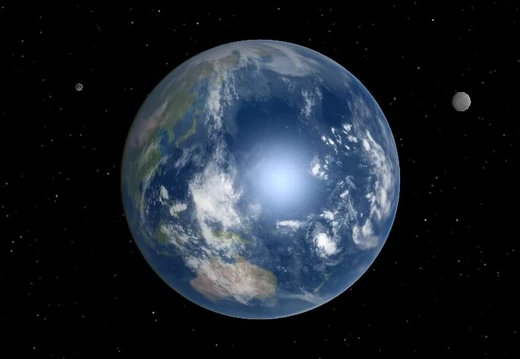
Rings of Earth
Hypothetical ring system that may have existed around Earth.
Earth’s rings are a speculative feature—a ring system that may currently encircle the planet or have done so in the past, though no such rings have been definitively proven. The term “geostationary ring” is sometimes used informally to describe the orbital region where artificial satellites and other objects reside in geostationary orbit.
**Effects**
A planetary ring would block sunlight from reaching the atmosphere and surface, casting a shadow whose position and size shift with the ring’s structure and the season. This could significantly alter Earth’s climate. A 2002 study modeled the impact of a dense equatorial debris ring—completely opaque, stretching from 9,758 to 12,310 kilometers in altitude, scaled from Saturn’s B ring. The results showed a drop in global average temperature, amplified by positive feedback from increased sea ice and snow cover. Tropical and subtropical regions under the ring’s shadow experienced especially severe cooling. This cooling reduced the temperature difference between the equator and the poles, weakening global tropospheric winds. Precipitation decreased in most areas, except in subtropical monsoon regions, where rainfall rose. Some of these climatic shifts might appear in geological records—for instance, changes in vegetation due to altered temperature and rainfall, or reduced atmospheric dust transport and smaller dust particles from weaker winds.
In a modern context, ring particles would endanger satellites in low Earth orbit, and the ring’s reflected light would appear far brighter than a full Moon at night.
**Proposed Past Natural Rings**
**Neoproterozoic** A planetary ring may have triggered a global glaciation during the Neoproterozoic, possibly initiating snowball Earth conditions. Once the high-albedo Earth became frozen, it could have remained ice-covered even after the rings dissipated. Other plausible causes, such as rapid carbon dioxide drawdown, also exist.
**Ordovician** In 2024, researchers proposed that Earth had a ring system during the Ordovician period, roughly 466 million years ago. The study identified 21 impact craters located within 30° of the equator at that time, even though about 70% of Earth’s crust suitable for preserving craters lies outside that band. The odds of all 21 craters falling within that 30° range were calculated at one in 25 million, interpreted as highly improbable unless th
- Type
- Hypothetical planetary ring system
- Proposed periods
- Neoproterozoic, Ordovician, Late Eocene
- Key effect
- Blocks incoming sunlight, potentially altering climate
- Notable study
- 2002 research paper on effects of dense equatorial debris ring
- Modern hazard
- Would endanger low Earth orbit satellites
Lore & Background
A 2002 research paper studied the effects of a dense equatorial debris ring on the climate of modern Earth. It assumed a completely opaque ring extending from 9,758 to 12,310 km, rescaled from Saturn's B ring. It found that the global average temperature decreased, partially enhanced by positive feedback from increased sea ice and snow cover, with tropical and subtropical regions shaded by the rings experiencing particularly severe cooling. The cooling of the tropics reduced the equator to a polar temperature gradient, which in turn reduced the strength of tropospheric winds globally. Precipitation decreases were noted in most regions, except in subtropical monsoon regions, where rainfall increased.
In 2024 it was proposed that Earth may have had a set of rings during the Ordovician period, approximately 466 million years ago. The study found 21 impact craters located within 30° of the Earth's equator at the time, despite the fact that ~70% of the Earth's crust suitable for the preservation of craters is located outside this band. The rings would have been created by an L chondrite parent body which passed near Earth within the Roche limit, causing it to break up and form a debris ring. The rings may have existed for up to 40 million years.
Reader's Guide
The concept of Earth having rings is significant because it offers a potential mechanism for past climate shifts and glaciation events. A planetary ring may have initiated a global glaciation event during the Neoproterozoic, possibly triggering snowball Earth conditions. The 2024 Ordovician proposal suggests that a decaying ring system could explain an unusual clustering of impact craters near the equator, with the rings shading the Earth and potentially causing the Hirnantian glaciation. However, a 2025 review noted that the temperature trend is gradual, while the ring system was expected to produce an abrupt cooling effect. Impact events during the late Eocene may have produced a transient debris ring which cooled the Earth over its lifetime of around a hundred thousand to a million years, though a 2024 study failed to identify climatic responses to those impacts. The idea remains hypothetical, with no rings confidently confirmed to have existed, but it provides a framework for understanding how debris rings could influence planetary climate and impact patterns.
Did You Know?
- A 2002 study assumed a completely opaque ring extending from 9,758 to 12,310 km, rescaled from Saturn's B ring.
- In a modern setting, ring particles would endanger low Earth orbit satellites, and reflected light from the ring would be much brighter than the full Moon at night.
- The 2024 Ordovician proposal found 21 impact craters within 30° of the equator, with the chances of that clustering being one in 25 million.
- The rings may have existed for up to 40 million years during the Ordovician period.
More in Hypothetical astronomical objects 1-24
Spotted an error? Know more?
This is a living reference — every entry is fact-audited, and reader corrections feed straight into our audit queue. Suggest an edit · See this site's audit record