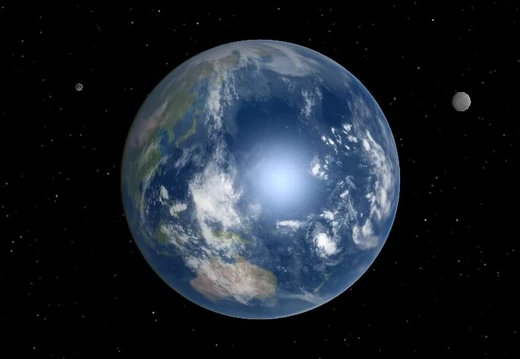
Shell collapsar
Hypothetical compact object without a central singularity.
A shell collapsar is a hypothetical object proposed as an alternative to black holes. Instead of a central singularity, matter in this model collapses onto the event horizon, creating an ultra-dense shell roughly the size of a neutron star (about 11 km in diameter). This shell bends light so strongly that it mimics a black hole’s appearance. The concept was introduced by Trevor W. Marshall in 2009 and 2012, with further development in 2016. It allows for neutron stars with masses exceeding the Tolman–Oppenheimer–Volkoff limit of 2.1 solar masses, offering an alternative explanation for the compact objects that merge and produce gravitational waves.
The theoretical groundwork for such massive neutron stars was explored by Jun Ni in 2011. Ni examined solutions to Einstein’s field equations that do not impose a maximum mass for neutron stars, challenging the conventional limit beyond which collapse into a black hole is expected. He described a new class of neutron stars that can exist beyond this traditional boundary, coining the Japanese term "超重星" (Chōjūsei), meaning "supermassive star." Luboš Neslušan proposed a similar solution where the gravitational potential minimum lies in the neutron star’s shell rather than its center, referencing Ni. deLyra has presented analogous models of shell-like compact gas objects. More recently, Matthew R. Edwards suggested a shell universe model based on Ni’s solutions to address the Hubble Tension.
A shell collapsar may be hollow inside, as time dilation indefinitely delays the entry of mass particles. However, Marshall’s solution predicts intense gravitational field energy in that interior, arising from Einsteinian gravitation in a highly non-linear regime. On the collapsar’s surface—just outside the event horizon—extreme time dilation causes accreting neutron matter to appear to freeze onto the outer shell, a process described in the ‘frozar’ model. Z. Zakir conceives that outward gravitational forces inside the object push inner matter into this frozar shell.
The shell collapsar is a specific type of gravastar. In a gravastar, an exotic form of matter with the equation of state of dark energy stabilizes the object. The shell collapsar achieves a similar result using ordinary neutron star matter and Einstein’s field equations, which describe an intense gravitational energy density comparable, as E/c², to the density of
- proposed_by
- Trevor W. Marshall
- first_proposed
- 2009 and 2012
- established
- 2016
- type
- hypothetical astronomical object
- size
- ~11 km (neutron star size)
- related_concept
- gravastar
- key_feature
- no central singularity
Lore & Background
The shell collapsar concept emerged from work by Trevor W. Marshall, who first proposed the term in 2009 and 2012, with further establishment in 2016. It describes a shell of ultra-high density matter formed by collapse onto the event horizon, lacking a central point-like singularity. This object is of neutron star size (~11 km) and strongly deflects light like a black hole. In 2011, Jun Ni explored theoretical frameworks of neutron stars within general relativity, discussing solutions to field equations that do not impose a maximum mass limit, challenging conventional understanding. Ni introduced a new class of neutron stars beyond the traditional limit, coining the term '超重星' (Chōjūsei), meaning 'supermassive star' in English. Luboš Neslušan suggested a solution with the gravitational potential minimum in the shell of the neutron star instead of the center, referencing Ni. deLyra showed similar models of shell-like compact gas objects. Matthew R. Edwards even suggested a shell universe model based on Ni's solutions to reduce the Hubble Tension.
Reader's Guide
The shell collapsar is significant as an alternative to the black hole model for highly compact objects, particularly those merging to produce gravitational wave signals. It challenges the conventional Tolman–Oppenheimer–Volkoff limit of 2.1 M☉ for neutron stars, allowing for higher masses without requiring a singularity. The concept is a special case of a gravastar, but unlike the gravastar, which requires exotic dark energy matter, the shell collapsar achieves similar results with ordinary neutron star matter and Einstein's field equations describing intense gravitational energy density. The interior may be void due to time dilation, or contain intense gravitational field energy as per Marshall's solution. The 'frozar' model describes accreting neutron matter freezing onto the outer shell due to extreme time dilation. Z. Zakir conceives outward gravitational forces pushing inner matter into the shell. This model preserves the observational signatures of black holes while avoiding singularities, offering a distinct theoretical path for understanding compact objects in general relativity.
Did You Know?
- The term shell collapsar was first proposed by Trevor W. Marshall in 2009 and 2012, then more firmly established in 2016.
- It predicts neutron star masses beyond the Tolman–Oppenheimer–Volkoff limit of 2.1 M☉.
- Jun Ni coined the term '超重星' (Chōjūsei), meaning 'supermassive star', for neutron stars beyond the traditional mass limit.
- The shell collapsar is a special case of a gravastar, but uses ordinary neutron star matter rather than exotic dark energy.
More in Hypothetical astronomical objects 1-24
Spotted an error? Know more?
This is a living reference — every entry is fact-audited, and reader corrections feed straight into our audit queue. Suggest an edit · See this site's audit record