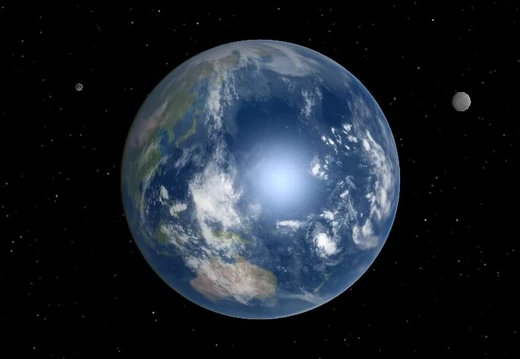
Subsatellite
A hypothetical natural satellite orbiting a moon.
A subsatellite—also called a submoon, moonlet, or informally a moonmoon—is a hypothetical natural satellite that orbits the moon of a planet. Based on studies of natural satellites in the Solar System, such objects are thought to be possible but rare in planetary systems. No subsatellite has ever been confirmed in the Solar System or elsewhere, aside from human-made spacecraft temporarily orbiting the Moon. In most cases, a planet’s tidal forces would make such an arrangement unstable over astronomical timescales.
In scientific literature, the terms “submoons” and “moon-moons” appear, while informal suggestions include moonitos, moonettes, and moooons.
Possible natural examples have been proposed. Saturn’s moon Rhea was once thought to have a ring system, which would imply stable orbits for subsatellites. However, Cassini images found no rings or subsatellites larger than a few millimeters, making that scenario unlikely. Another Saturnian moon, Iapetus, may have once had a subsatellite. One hypothesis suggests an ancient giant impact created a subsatellite; as Saturn slowed Iapetus’s rotation, the subsatellite’s orbit decayed until it crossed Iapetus’s Roche limit, forming a transient ring that later impacted the surface, creating Iapetus’s unusual equatorial ridge. This could have happened on other giant-planet moons, but only on Iapetus—and possibly Uranus’s moon Oberon—would the ridge have formed after the Late Heavy Bombardment and survived to the present day. Among Saturn’s irregular moons, light-curve analysis suggests Kiviuq is extremely prolate and likely a contact binary or binary moon; Bestla, Erriapus, and Bebhionn are also candidates.
Artificial subsatellites have been limited to Earth’s Moon. The first spacecraft to orbit the Moon was Luna 10 in 1966. As of 2024, no spacecraft has successfully orbited any other natural satellite. In 1988, the Soviet Union attempted to put two robotic probes into quasi-orbits around Mars’s moon Phobos, but failed. Currently, NASA’s Lunar Reconnaissance Orbiter (launched June 18, 2009) orbits the Moon in an eccentric polar mapping orbit, providing data for future human and robotic missions. Different lunar orbits suit different goals: low polar orbits for global mapping, and near-rectilinear halo orbits (NRHOs) for long-term stability and continuous Earth communication. The CAPSTONE project, launched June 28, 2
- field
- Astronomy / Planetary Science
- known_for
- Hypothetical moon of a moon
- type
- Hypothetical natural satellite
- first_artificial_example
- Luna 10 (1966, orbited Earth's Moon)
- notable_candidate_host
- Kepler-1625b I (exomoon)
Lore & Background
The concept of a subsatellite arises from the study of natural satellite systems. In the Solar System, giant planets have large collections of moons, but no subsatellite has been confirmed. The exomoon Kepler-1625b I, orbiting the exoplanet Kepler-1625b, is theoretically large enough to host a subsatellite. Tidal forces from the parent planet generally make such orbits unstable over long timescales.
Possible natural instances have been proposed. Saturn's moon Rhea was suspected of having a ring system that could imply shepherd moons, but Cassini spacecraft images found no particles larger than a few millimeters. Saturn's moon Iapetus may have once possessed a subsatellite formed by an ancient giant impact; as Saturn despun Iapetus, the subsatellite's orbit decayed, crossed the Roche limit, and formed a transient ring that impacted Iapetus to create its equatorial ridge. This scenario could have occurred on other giant-planet satellites, but only for Iapetus and perhaps Oberon would the ridge have survived to the present day.
Light-curve analysis suggests that Saturn's irregular moon Kiviuq is extremely prolate and likely a contact binary or binary moon, with other candidates including Bestla, Erriapus, and Bebhionn. Artificial subsatellites include many spacecraft that have orbited Earth's Moon, starting with Luna 10 in 1966. As of 2024, no spacecraft has successfully orbited any other natural satellite, though the Soviet Union attempted quasi-orbits around Phobos in 1988.
Reader's Guide
Subsatellites represent a frontier in planetary science, bridging the study of moon systems and orbital dynamics. Their rarity in the Solar System, inferred from tidal instability, highlights the delicate balance required for such orbits. The possible detection of rings around Rhea and the proposed ancient subsatellite of Iapetus illustrate how subsatellites could explain unusual surface features, such as Iapetus's equatorial ridge. The concept also extends to exoplanetary systems, where the large exomoon Kepler-1625b I could theoretically host a subsatellite, opening questions about habitability and system architecture. Artificial subsatellites, like the Lunar Reconnaissance Orbiter and CAPSTONE, demonstrate practical applications in lunar exploration, testing orbits like near-rectilinear halo orbits for future missions such as the planned Lunar Gateway. The study of subsatellites informs our understanding of planetary formation, tidal evolution, and the potential for complex satellite systems elsewhere in the universe.
Did You Know?
- No subsatellite is known in the Solar System or beyond, aside from human-launched satellites in temporary lunar orbit.
- Saturn's moon Iapetus may have once possessed a subsatellite that formed its equatorial ridge after orbital decay.
- The exomoon Kepler-1625b I is theoretically large enough to host a subsatellite.
- As of 2024, no spacecraft has successfully orbited any natural satellite other than Earth's Moon.
More in Hypothetical astronomical objects 1-24
Spotted an error? Know more?
This is a living reference — every entry is fact-audited, and reader corrections feed straight into our audit queue. Suggest an edit · See this site's audit record