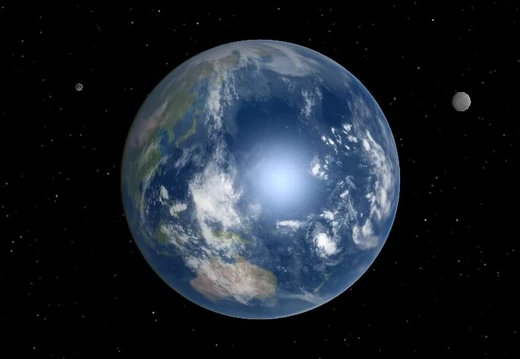
Theia (hypothetical planet)
Hypothetical planet whose collision with Earth formed the Moon.
Theia is a hypothetical ancient planet in the early Solar System that, according to the giant-impact hypothesis, collided with the proto-Earth around 4.50 billion years ago. Some of the resulting ejected debris re-coalesced to form the Moon. Theia is named after the Greek Titan who was the mother of Selene, the goddess of the Moon, paralleling its theorized role in creating the Moon.
- Type
- Hypothetical ancient planet
- Hypothesized size
- About the size of Mars
- Hypothesized mass
- About 10% of modern Earth's mass (some estimates range up to 40–45%)
- Hypothesized orbit
- Originally at L4 or L5 Lagrange points of Earth–Sun system; later studies suggest semi-major axis between 1.16 AU and 1.195 AU
- Collision date
- Around 4.50 billion years ago
- Known for
- Colliding with proto-Earth to form the Moon
Lore & Background
The composition of Theia and how different it was from Earth is disputed. A key constraint has been that many isotope ratios of lunar rocks are nearly identical to those from Earth, implying either extensive homogenization by the collision or that Theia's isotopic composition was very similar to Earth. However, a 2020 study showed that lunar rocks were more variable in oxygen isotope composition than previously thought, with some differing more from Earth, possibly indicating that Theia formed further away from the Sun than Earth. Simulations suggest that Theia would be responsible for around 70–90% of the total mass of the Moon under a classic giant impact scenario where Theia is considerably smaller than proto-Earth.
Reader's Guide
Theia is central to the giant-impact hypothesis, one of four historical hypotheses for the origin of the Moon. The hypothesis gained support from Apollo lunar rock samples, which were found to be very similar in composition to Earth's crust, suggesting they were removed from Earth in a violent event. Collision simulations support the idea that the two large low-shear-velocity provinces in Earth's lower mantle may be remnants of Theia, a hypothesis reinforced by computer simulations in 2023. Theia's hypothetical nature and the ongoing debate about its composition and origin highlight the complexity of early Solar System dynamics. Theia's story illustrates how a single catastrophic collision could have shaped the Earth–Moon system, and its remnants may still be present deep within Earth. The hypothesis continues to be refined through isotopic analysis and computer modeling, making Theia a key figure in planetary formation theories.
Did You Know?
- Theia is hypothesized to have been about the size of Mars, with a mass about 10% of modern-day Earth, though some estimates suggest it may have been up to 40–45% of Earth's mass.
- Theia is named after the Greek Titan who was the mother of Selene, the goddess of the Moon.
- Collision simulations suggest that the two large low-shear-velocity provinces in Earth's lower mantle may be remnants of Theia.
- A 2020 study found that lunar rocks are more variable in oxygen isotope composition than previously thought, with some values possibly reflecting Theia's composition.
More in Hypothetical astronomical objects 1-24
Spotted an error? Know more?
This is a living reference — every entry is fact-audited, and reader corrections feed straight into our audit queue. Suggest an edit · See this site's audit record